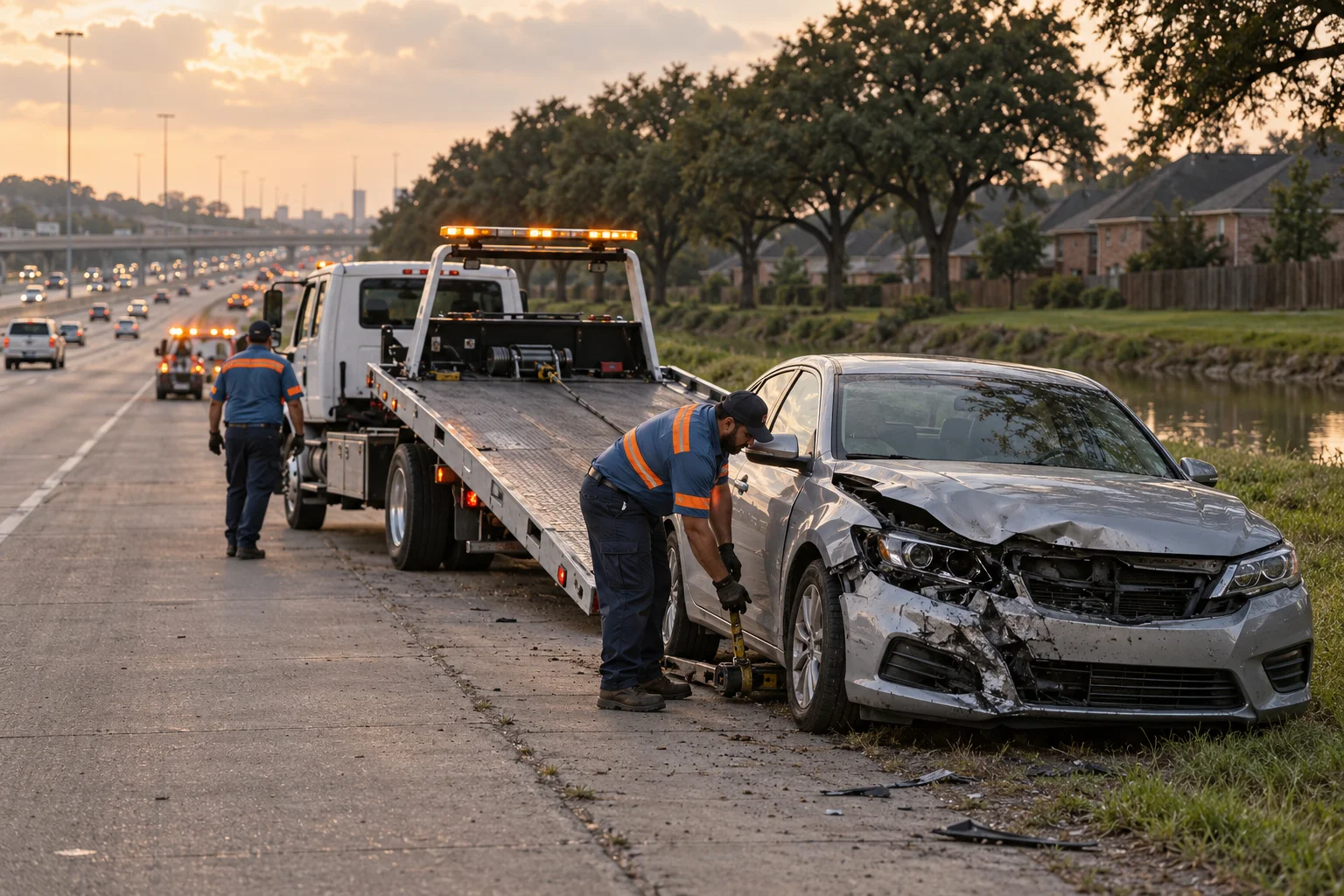
After a crash in Spring, your car can go to a repair shop, dealership, home, another approved property, or a licensed storage facility. Choose before dispatch when possible, then confirm that the destination will accept the vehicle.
Quick Tow Houston connects callers with licensed, insured towing operators. We handle intake and dispatch, but the operator performs the recovery and sets the price.
Share the crash location before dispatch
“Spring” alone doesn’t give an operator enough location detail. A crash near I-45 requires a different approach from one near the Hardy Toll Road or Grand Parkway. Start with the road name, travel direction, nearest exit, and a visible cross street.
Say whether the vehicle is on the main lanes, a frontage road, or nearby property. If you’re near an interchange, name both roads. A dropped map pin can help, but pair it with spoken details. Pins sometimes land on the opposite side of a divided highway.
Also describe the vehicle’s position and condition without guessing about damage. Tell dispatch whether it’s upright, off the pavement, against a barrier, or blocked by another vehicle. Mention loose wheels, locked steering, or missing keys if you can confirm them. Those details help the operator decide what equipment the recovery may require.
If a responding agency has already directed the vehicle’s movement, share those instructions exactly. Don’t assume the destination. Ask where the vehicle is being taken and write down the answer.
For a crash on a freeway, don’t assume Houston’s Tow and Go program covers that location. The program provides certain freeway assistance, but it excludes tollways and Katy Freeway HOT lanes. Eligibility also depends on the circumstances and authorization. Check the official program information or ask the responding authority.
Our accident recovery and winch-out service page explains how we route calls requiring more than a basic vehicle move.
Choose a destination before the operator arrives
The right destination depends on what happens next. A repair shop may make sense when you already know who will inspect the car. A dealership may suit a vehicle with brand-specific service needs. Home or another private property can work only when the recipient permits it and the operator agrees.
Call the destination before dispatch. Confirm that it accepts accident-damaged vehicles and can receive yours when it arrives. Ask where the operator should leave it. A shop’s public address might not identify the correct entrance, gate, or receiving area.
If you’re comparing a dealership with an independent shop, use our guide to choosing a dealership or repair shop. That decision is easier before the vehicle is loaded.
A licensed Vehicle Storage Facility, often called a VSF, is another possible destination. Texas requires VSFs to hold a TDLR license. Storage and related charges can begin after arrival under state rules, so ask which facility would receive the car and confirm its current release process directly.
Houston doesn’t operate one universal city impound lot. City and police-directed tows go to a network of private, licensed facilities. The City of Houston lookup at findmytowedcar.com can locate qualifying Houston tows by plate or VIN.
Spring crash locations aren’t automatically City of Houston cases. The road, boundary, and responding jurisdiction matter. If someone else directs the tow, ask that authority which lookup or facility applies. When that isn’t clear, record the agency name and ask where its directed vehicles are stored.
I-45, Hardy Toll Road, and Grand Parkway access
Access matters as much as the Spring address. I-45’s main lanes, frontage roads, ramps, and nearby intersections create distinct pickup points. “Near I-45” can still place the operator on the wrong side of several lanes.
Give the direction of travel first. Then name the exit you passed or were approaching. If you left the main lanes, say whether you reached the northbound or southbound frontage road. Don’t describe a frontage-road location as though the car remains on the freeway.
The Hardy Toll Road creates another important distinction. Tell dispatch if the vehicle is on the toll road itself, an entrance or exit ramp, or a connecting street. Houston Tow and Go excludes tollways, so don’t rely on that program for a Hardy Toll Road crash. Ask the responding authority or operator what applies at the exact location.
Grand Parkway locations need the same precision. “Grand Parkway near Spring” covers too much road for a useful dispatch description. Share the direction, nearest exit, intersecting road, and whether the vehicle is before or beyond the ramp.
A destination across one of these corridors may change the recovery plan. Give its full name and street address, not only “the nearest body shop.” The operator can then review access and quote the work before the truck rolls.
If the vehicle is obstructing travel or remains under official control, follow the responding authority’s directions. Quick Tow Houston can route an emergency towing request, but we don’t control the roadway, assign police-directed tows, or promise an arrival time. Ask the operator for an arrival estimate after the location and recovery details are confirmed.
What to confirm with the operator
Confirm the operator’s identity, the destination, and the quoted price before pickup when circumstances allow. Quick Tow Houston doesn’t set towing prices. The operator performing the work sets and collects the charge.
Ask whether the quote covers the recovery described during intake. A vehicle resting on its wheels may require different work than one off the pavement or against a barrier. If the scene changes, ask the operator to explain any revised plan and price before proceeding.
Texas requires tow operators to be licensed by the Texas Department of Licensing and Regulation. You can verify a license through TDLR’s license search. The state also publishes consumer information about towing.
The approved statewide maximum for a non-consent tow of a vehicle weighing 10,000 pounds or less is $272 under 16 TAC Chapter 85. That figure is a state maximum for non-consent towing, not a Quick Tow Houston price or a universal accident-tow quote.
Inside the City of Houston, the municipal light-duty non-consent rate effective January 1, 2026, is $232 for the first 20 miles, then $4.64 per mile beyond 20. That rate comes from Houston Municipal Code Chapter 8. It shouldn’t be applied automatically to every Spring crash. Confirm the jurisdiction and applicable rate with the operator or directing authority.
Before the car moves, repeat the exact destination. Ask what happens if the shop refuses delivery or its gate is closed. If storage becomes necessary, ask for the facility’s name and address. For more context about non-consent towing, read our guide to Houston towing rights.
Records to keep after the vehicle moves
Keep the operator’s name, company information, quoted price, and payment record. Write down the pickup location and destination. Record the date and the approximate time the vehicle left the scene.
Save any dispatch messages and destination confirmation. Keep photos you already took of the vehicle and its position. If a repair shop accepted the car, note who confirmed receipt. If it went to storage, retain the facility name and every document provided.
Don’t rely on memory after a stressful crash. A short written timeline helps when speaking with the operator, repair facility, insurer, or responding agency. Keep each name and instruction tied to the person or organization that gave it.
If you can’t locate the vehicle afterward, start with the authority that directed the tow. City of Houston tows can be searched through findmytowedcar.com. Harris County has a separate towing lookup, so the correct search depends on where the tow originated and who directed it.
Texas sets specific storage charges for licensed VSFs. Under 16 TAC Chapter 85, the approved daily rate effective January 1, 2024, is $22.85 for a vehicle 25 feet or shorter and $39.99 for a vehicle longer than 25 feet. Storage begins six hours after the vehicle arrives. Those are state-regulated facility charges, not prices set by Quick Tow Houston.
If you believe a non-consent tow lacked probable cause, Texas law provides a tow-hearing process. A written request generally must be filed before the 14th day after removal, excluding weekends and holidays. Because deadlines and filing details matter, check the documents provided by the tower or VSF and contact the appropriate justice court.
When to call us
Call when a crash-damaged vehicle in Spring needs a licensed towing operator and you know the pickup location, vehicle condition, and preferred destination. Call us at (281) 916-1288 and we’ll connect you with an operator who handles this work.