Classic car towing in Houston starts with a careful dispatch conversation. Share the car’s condition, access limits, and destination before an operator accepts the job. That preparation helps the operator assess the request without guessing about your vehicle.
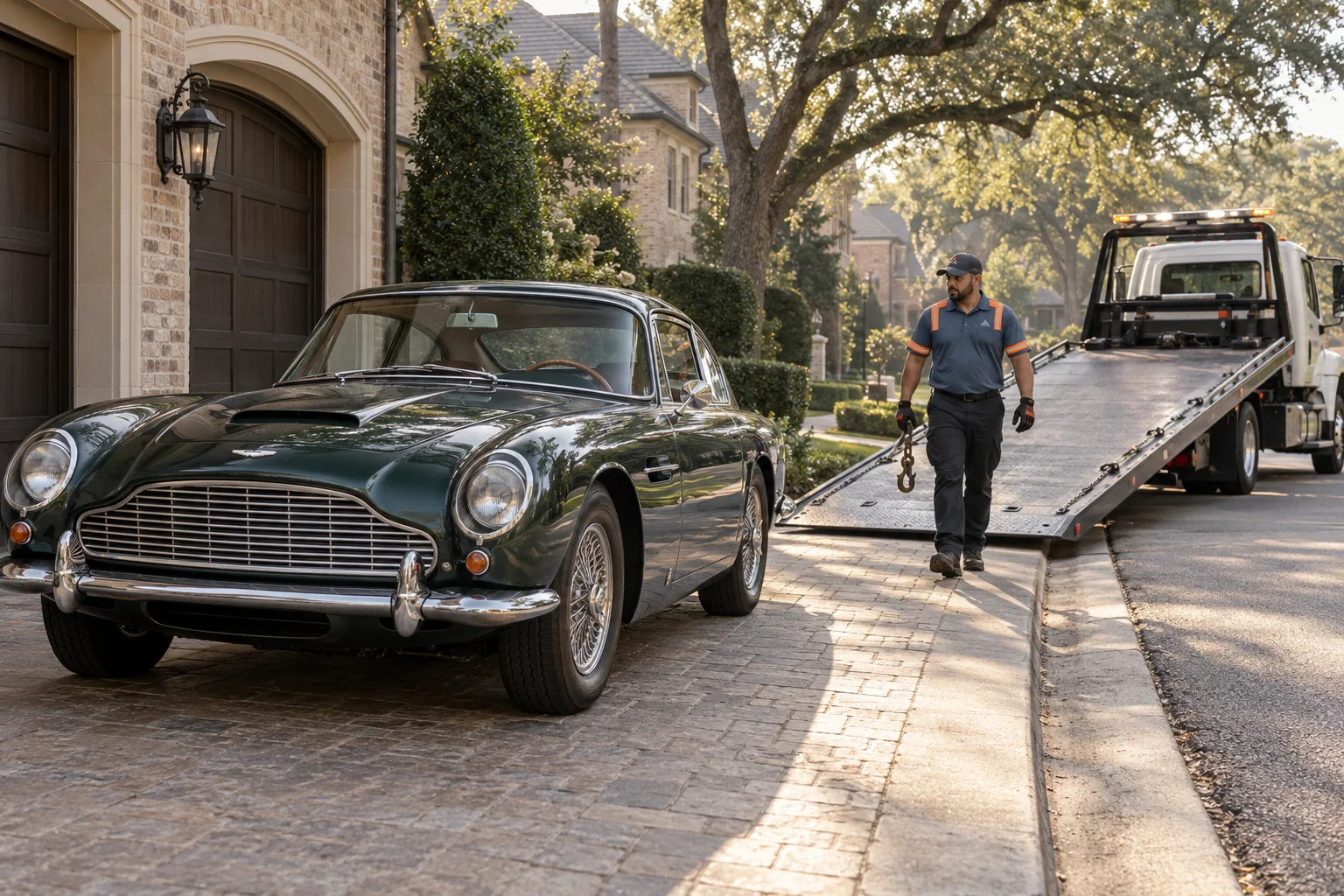
Vehicle details to share before dispatch
Start with the year, make, model, and body style. Tell us whether the car is stock, restored, lowered, or modified. Mention changes to the wheels, suspension, bodywork, or exhaust if you know them.
Then describe why the car needs transport. It may run normally but shouldn’t be driven. It may have a mechanical problem, collision damage, or an unknown condition after storage. Don’t diagnose it for dispatch. Describe what you can see and what happened before it stopped moving.
The operator also needs the pickup and destination addresses. Houston distances can change sharply across the metro. A short move within River Oaks differs from a trip west along I-10 or south toward the Bay Area. Mention any planned freeway travel, including I-45, Loop 610, or Beltway 8.
Share these details if they’re known:
- Whether the engine starts
- Whether the transmission can select neutral
- Whether the steering wheel turns
- Whether the tires hold air
- Whether the parking brake releases
- Whether you have the keys
- Whether parts extend below the usual body line
- Whether the vehicle has removable panels or accessories
Say “unknown” when you can’t confirm something. That’s more useful than a guess.
Texas requires tow operators to hold a TDLR license. You can review state consumer information through the Texas Department of Licensing and Regulation. Quick Tow Houston connects callers with licensed, insured operators, but the customer contracts directly with the operator performing the work.
Our exotic and classic car towing service explains how the referral process works.
Ground clearance, loose parts, and nonrunning cars
Low clearance deserves attention before dispatch. Don’t rely on labels like “lowered” or “very low.” Check the vehicle manual, restoration records, or build sheet for documented measurements. If no reliable figure exists, tell the operator that clearance hasn’t been confirmed.
Point out anything that may affect access or loading. That includes front splitters, side pipes, spoilers, custom exhaust parts, running boards, and body panels that don’t sit securely. Don’t remove or adjust unfamiliar parts based on general online advice. Consult the vehicle documentation, restoration shop, or operator first.
Walk around the car from several angles. Look for loose trim, open panels, fluid beneath the vehicle, and tires that appear low. Report what you observe without declaring the cause. The operator can then discuss the proposed loading plan with you.
A nonrunning car needs a clear condition report. Explain whether it stopped on the road, failed to start in storage, or arrived that way after a purchase. Tell dispatch if the wheels appear turned, locked, damaged, or blocked. If you don’t know whether the car can roll, say so directly.
Don’t promise the operator that you’ll move the vehicle manually. Don’t attempt a recovery procedure that isn’t covered by the owner’s documentation. The operator must decide how the vehicle can be handled at the actual pickup site.
Some owners ask for flatbed classic car transport. Equipment selection still belongs to the operator after reviewing the car and location. Read about flatbed towing in Houston and when a flatbed may be requested before discussing the plan.
Home garages, storage units, and Houston event lots
The car’s parking spot matters as much as its condition. Give dispatch a plain description of the route from the vehicle to the street. Include doors, gates, ramps, columns, parked cars, and other fixed obstacles.
For a River Oaks garage pickup, note whether the car faces inward or outward. State whether another vehicle blocks it. Share any measured garage opening, driveway, or gate dimensions. Don’t estimate a tight measurement by sight.
Storage facilities have their own access conditions. Confirm the property’s current entry rules with its manager. Ask whether the operator needs advance permission, a gate code, identification, or an escort. Also confirm the space number and the correct entrance. Don’t assume every gate reaches every building.
At an event lot, arrange a specific meeting point with the property representative. Houston venues and temporary shows may control where commercial vehicles enter or stop. Ask the organizer or property manager for the current instructions. We can’t confirm a site’s rules without speaking to the authority that sets them.
Location details should include:
- The vehicle’s exact level, row, unit, or space
- The surface between the car and exit
- Any posted height or access restriction
- A gate contact or property representative
- Whether you’ll be present
- Any deadline imposed by the property
A pickup near central Houston may require a different approach than one near Katy, Pasadena, or Galveston. Distance, road network, and jurisdiction all matter. Give the full address rather than a neighborhood name alone.
Don’t leave keys with an unconfirmed person or in an exposed location. If you can’t attend, ask the operator what authorization and handoff process it requires.
How to choose the destination
Choose a destination that has agreed to receive the car. Call the restoration shop, mechanic, dealership, storage facility, or owner before dispatch. Confirm the address, current receiving instructions, and where the operator should place the vehicle.
A shop name isn’t enough. Houston businesses may have separate customer, service, and delivery entrances. Ask the recipient which entrance the operator should use. Get a contact name when possible, then share it during dispatch.
Match the destination to the reason for transport. A mechanical problem may call for a repair shop familiar with that vehicle. A restoration project may be going to a specialist. A recent purchase may need storage rather than immediate repair. Quick Tow Houston doesn’t choose the business or guarantee its work.
If you’re deciding between two destinations, consider:
- Which location has accepted the vehicle
- Whether it can receive a nonrunning car
- Whether someone will meet the operator
- Whether the property has access restrictions
- Where the keys and paperwork should go
- Whether the trip extends beyond the Houston area
Don’t assume an operator can leave a classic car outside a closed business. Confirm the handoff plan directly with both the operator and recipient. If the destination changes after dispatch, contact the operator before the vehicle moves.
A local tow also differs from a broader vehicle-shipping request. If the car is moving outside the Houston area, explain the full route before accepting the operator’s terms. Ask whether that request falls within the operator’s service scope.
Our guide to choosing a dealership or repair shop destination covers more questions to ask. The operator sets the price, so confirm the price and payment terms directly before dispatch.
What to inspect with the operator before transport
Meet the operator at the vehicle when possible. Walk around the car together before loading begins. This creates a shared record of the condition both parties can see.
Take clear photos of the front, rear, both sides, wheels, glass, roof, and interior. Include close views of existing scratches, cracks, loose trim, and damaged panels. Photos don’t create a damage guarantee, but they document what was visible before transport.
Ask the operator to explain the proposed plan. Don’t tell the operator which attachment point or loading method to use based on a generic article. Classic cars differ, and modifications may not appear in factory documentation. Provide the owner’s manual, restoration notes, or builder instructions when available.
Confirm these points directly:
- The correct pickup and destination
- The car’s running and rolling condition
- The location of keys
- Any existing exterior damage
- Any loose or removable parts
- The planned handoff at the destination
- Who to contact if the destination can’t receive it
- The operator’s price and payment terms
Ask the operator for its license information if you haven’t verified it. TDLR offers a license search through its website. You can also ask the operator about its insurance and request the applicable coverage terms. Quick Tow Houston doesn’t issue the policy or make coverage decisions.
Before the operator leaves, make sure the recipient knows the car is coming. Keep your photos, operator information, and destination contact together. Inspect the vehicle again during delivery, before the handoff is complete.
When to call us
Call when a classic, antique, restored, exotic, or modified car needs a licensed towing professional in Houston. Share the vehicle condition, pickup access, and confirmed destination during intake. Call us at (281) 916-1288 and we’ll connect you with an operator who handles this work.