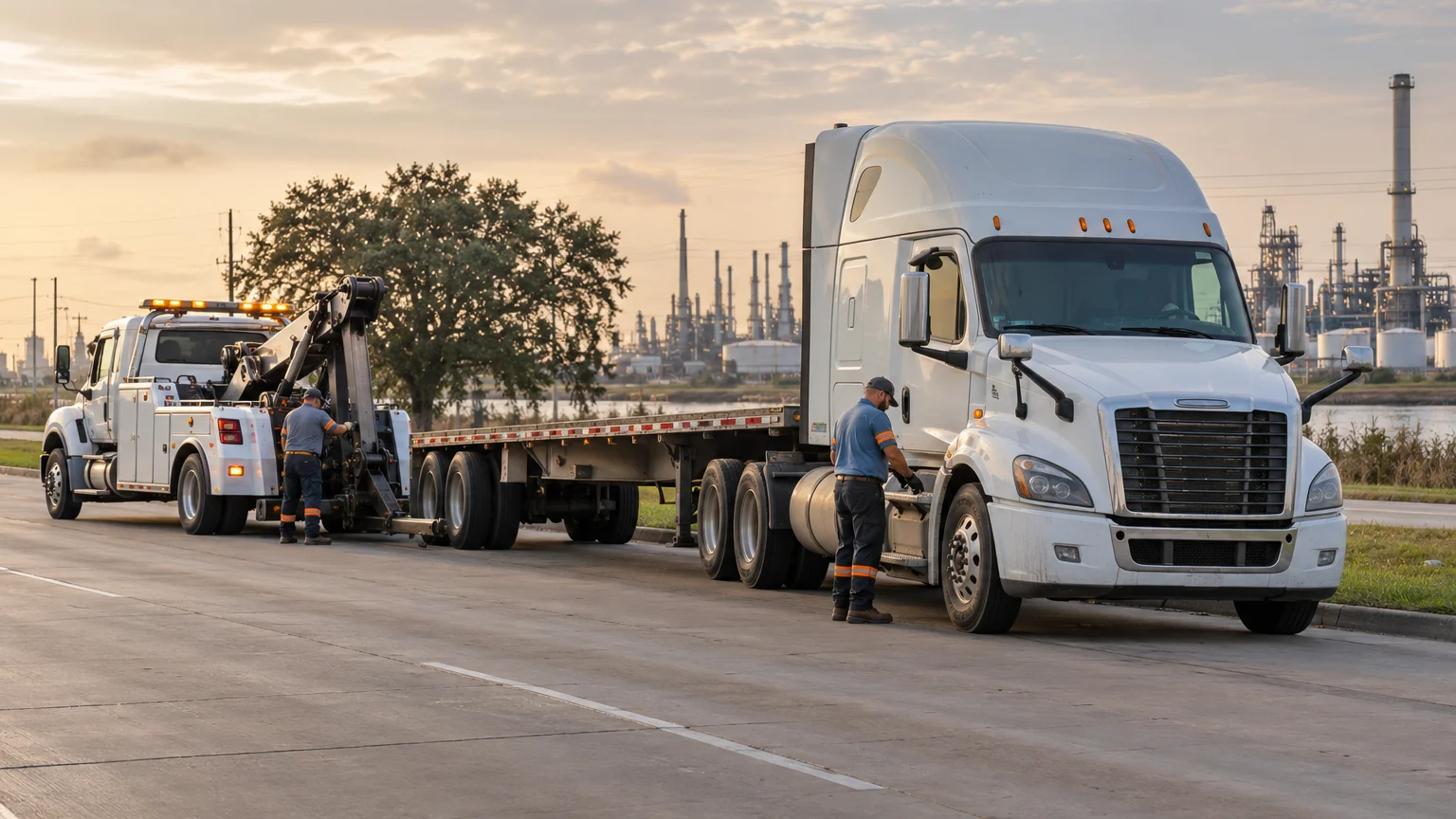
A heavy truck breakdown near Baytown needs a precise report before dispatch. If you’re searching for “24 hour heavy duty truck towing near me,” start by documenting the truck, load, location, road access, and intended destination. Around-the-clock availability can’t be guaranteed, so confirm availability directly with the operator.
Identify the truck and disabled unit
Begin with the truck’s exact year, make, model, and configuration. Don’t stop at “big rig” or “commercial truck.” Those descriptions don’t tell an operator enough to plan the call.
State whether the disabled vehicle is a tractor, straight truck, dump truck, bus, or another commercial unit. If a trailer is attached, describe it separately. Tell the dispatcher whether it’s a dry van, flatbed, tanker, container chassis, or another trailer type. If you’re unsure, share the manufacturer information shown on the unit.
Report which part has failed or appears damaged. A tractor that won’t start presents a different situation from a unit with steering, suspension, or wheel damage. Don’t diagnose an unfamiliar mechanical problem. Describe what you can see, hear, or smell without entering traffic or touching damaged equipment.
Also tell the dispatcher which axles or wheels appear affected. Mention whether the truck remains upright and whether the tractor and trailer still align normally. Report detached parts, visible leaks, or damage around the coupling area. Keep your distance from anything unstable.
Have the truck’s overall dimensions and manufacturer specifications ready when available. Don’t guess its weight, capacity, or required towing equipment. The operator must compare the vehicle and load information with the equipment available.
Our heavy-duty towing referral service connects callers with licensed, insured operators. Texas requires tow operators to hold the appropriate TDLR license. You can check a provider through the TDLR towing consumer information page.
Describe cargo, attachments, and road access
Cargo changes what the operator needs to evaluate. Report whether the truck is loaded, empty, or carrying a partially delivered load. Give the cargo description from the bill of lading or dispatch record. Don’t estimate a load when the paperwork provides a confirmed figure.
Tell the operator about every attachment affecting the vehicle’s shape. That includes a sleeper, liftgate, mounted equipment, refrigeration unit, headache rack, or trailer-mounted machinery. Mention anything hanging low, extending beyond the body, or damaged during the breakdown.
If the load has shifted, say so plainly. Don’t open a sealed trailer or climb onto cargo to inspect it. Report visible leaning, bulging, loose material, or an unusual trailer angle from a safe position. The operator can decide what additional information or support is needed.
Be equally specific about access. Baytown calls can occur near refineries, warehouses, frontage roads, parking areas, or loading entrances. The Port of Houston and the Baytown, Pasadena, and Deer Park refinery complex generate substantial heavy-truck traffic. A location that handles commercial vehicles may still have a narrow gate, low clearance, soft shoulder, or restricted turning space.
Tell dispatch whether the truck is on pavement, gravel, mud, or another surface. Report nearby barriers, gates, parked trailers, overhead structures, and tight corners. If security controls the entrance, explain how the operator should reach the disabled unit.
A truck that left the pavement or sustained collision damage may require accident recovery and winch-out coordination. Don’t attempt to pull, separate, or reposition the unit yourself. Describe the scene and let the operator confirm the recovery plan.
Report the exact position before dispatch
A street name alone isn’t enough around Baytown. Give the route, direction of travel, nearest exit, and closest visible landmark. State whether the truck is on the main lanes, a frontage road, an entrance ramp, an exit ramp, or private property.
Share a map pin when possible. Then verify that the pin matches the truck’s actual side of the road. A pin across an interchange can send an operator toward the wrong approach. Written directions remain useful when mapping apps place industrial entrances incorrectly.
Describe where the cab sits relative to traffic. Tell the dispatcher whether the truck is fully outside the traveled lane or still affecting a lane. Texas law generally restricts stopping on the main traveled portion of a highway when pulling off is practical. Disabled vehicles are an exception, but the scene may still expose the driver and other road users to danger.
Don’t stand in a live lane to inspect damage, take photos, or direct traffic. Follow instructions from law enforcement and roadway personnel at the scene. If the truck can’t be approached safely, say that before dispatch.
Private industrial property needs another layer of detail. Provide the facility name, gate identifier, check-in instructions, and the name of an authorized contact. Confirm whether security requires driver identification or advance approval. Don’t claim access permission unless the property representative has given it.
Quick Tow Houston is a dispatch and referral service. We collect the location details and route the request to an appropriate operator. The operator controls truck selection, approach, and arrival planning. Ask that operator for an arrival estimate after the location and access details are confirmed.
I-10, SH 146, and Spur 330 considerations
Baytown sits within a road network where a small location error matters. If the breakdown is near I-10, report whether you’re eastbound or westbound. Add the exit, frontage-road direction, and the nearest cross street or business entrance.
For SH 146, include your direction and whether you’re on the highway, a connector, or nearby property. Don’t describe the location as simply “near 146.” The operator needs a route that reaches the correct side without relying on assumptions.
Spur 330 also requires a clear direction and position. State whether the truck is before or after the nearest exit from your direction of travel. If you entered from another highway, mention that route. This helps distinguish adjoining ramps and frontage-road segments.
Industrial destinations can create confusion when a mailing address differs from the truck entrance. Ask the facility contact which gate commercial vehicles use. Report any posted access instructions without paraphrasing them. If the gate is closed or blocked, tell dispatch before the operator commits to an approach.
Conditions can also change while the call is being arranged. If law enforcement moves the truck, closes an approach, or directs traffic elsewhere, update dispatch immediately. Send a new map pin if the truck’s position changes.
For breakdowns farther west near the Ship Channel, our guide to heavy-duty towing around the Houston Ship Channel covers that separate operating area. Baytown reporting should remain centered on the actual route, direction, gate, and access point involved in this call.
Confirm equipment and destination with the operator
The operator must confirm what equipment fits the vehicle and situation. Provide the truck specifications, load documents, damage description, photos, and access notes. Don’t request a particular recovery method based only on a web search or a past tow.
Ask the operator to repeat back the vehicle configuration. Confirm that the trailer status, cargo condition, damaged area, and surface conditions were understood. If the unit has manufacturer towing instructions, share them before work begins.
The destination matters before dispatch. Decide whether the truck should go to a repair shop, dealership, fleet yard, terminal, or another approved location. Check that the destination accepts the vehicle type and can receive it when the operator expects to arrive. Our guide to choosing a dealership or repair shop destination explains what to confirm before pickup.
Provide the destination’s complete address and correct commercial entrance. Add a contact name if the property requires approval. Tell the operator about gate controls, turning limits, or other instructions supplied by the destination. Don’t assume the public entrance can accommodate a disabled tractor-trailer.
Price is set by the operator, not Quick Tow Houston. Ask the operator what information affects the quoted price and confirm the terms before the truck rolls. We don’t publish a brand tow rate or promise a specific price structure.
Finally, confirm who can authorize the tow. That may be the driver, fleet dispatcher, owner, insurer, or another representative. Keep that person reachable while the operator reviews the job. Clear authority reduces confusion when the truck, trailer, cargo, and destination involve different parties.
When to call us
Call when a disabled heavy truck near Baytown needs a licensed towing operator and the vehicle can’t continue safely. Call us at (281) 916-1288 and we’ll connect you with an operator who handles this work.