Your car has stopped, and you need to choose the right help. Searching “roadside assistance near me” makes sense when the problem may be handled where you stopped. A tow truck is the better request when the vehicle must be moved.
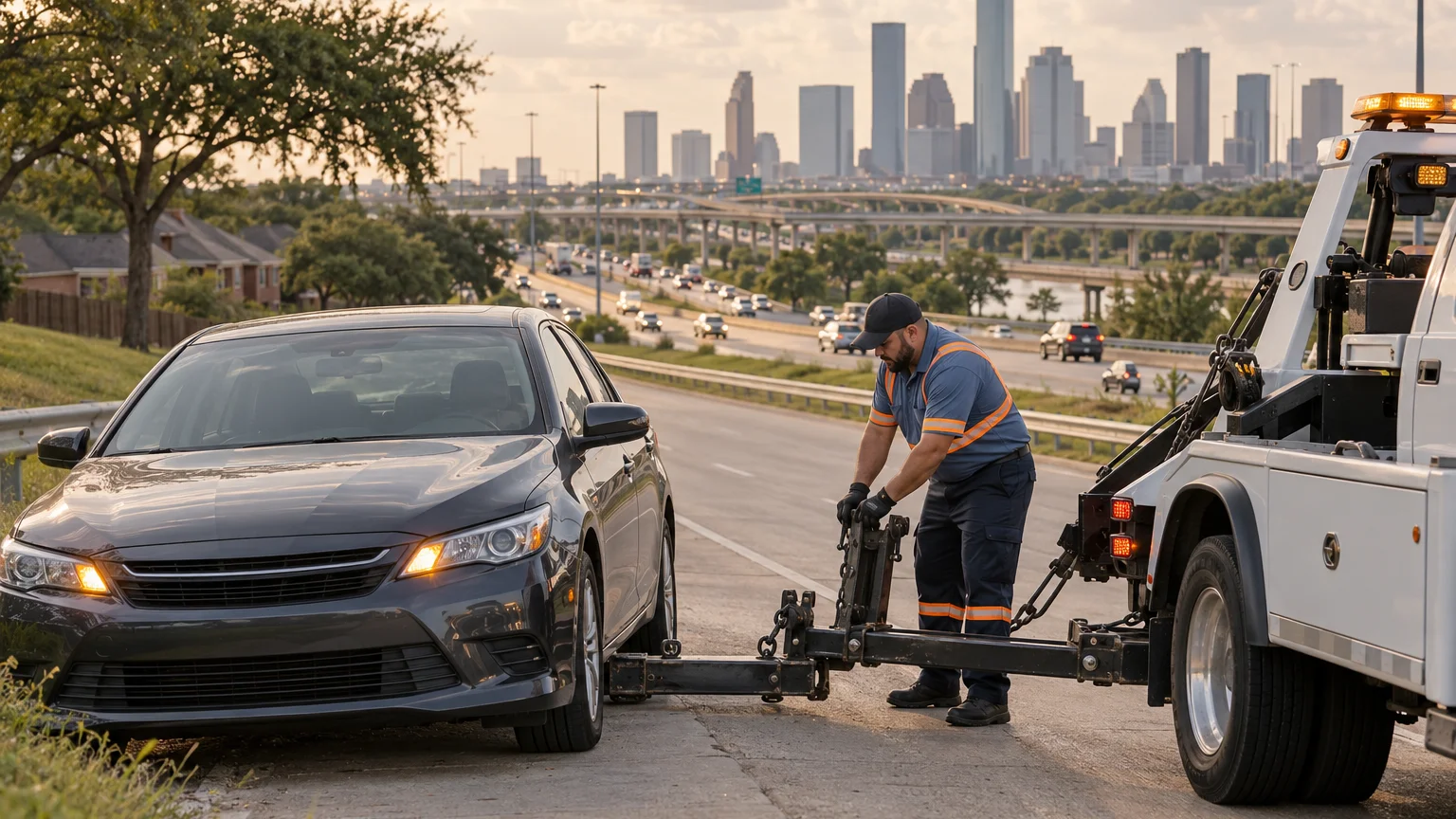
Problems roadside assistance may handle where you stopped
Roadside assistance focuses on a limited problem at the vehicle’s location. The goal is to determine whether the car can leave without being transported. It isn’t a promise that every breakdown can be repaired there.
A dead battery is one common example. An operator may inspect the situation and attempt a jump start. If the vehicle starts, the operator can explain what happened during the service call. A car that still won’t start may need towing for further diagnosis.
A flat tire may also fit a roadside call. Tell dispatch whether you have an inflated spare and the correct wheel-lock key. A missing, damaged, or unsuitable spare changes what the operator can do. The car may need to move to a tire shop instead.
Other possible roadside calls include an empty fuel tank or locked vehicle. Give the operator the fuel type before dispatch. For a lockout, report whether the key is visible inside, missing, or damaged. The operator decides whether the requested service fits the vehicle and situation.
Houston location matters too. A parking lot in Spring Branch gives an operator different access than a narrow shoulder beside Loop 610. Gulfton apartment parking, an Energy Corridor garage, and an East End industrial entrance can each create access issues. Report gates, height limits, traffic, and your exact parking position.
Our roadside assistance service connects you with licensed, insured operators. The operator will assess whether the problem can be handled where the vehicle sits. If you’re looking for help without a motor-club plan, read our guide to roadside assistance without AAA membership.
Problems that usually require moving the vehicle
Request a tow when the car can’t leave its location under its own power. Towing is also the clearer choice when a roadside attempt won’t address the underlying problem.
Collision damage often requires vehicle transport. The same applies when a wheel won’t turn, steering doesn’t respond normally, or the vehicle can’t shift into the needed position. Tell dispatch what you can observe. Don’t diagnose damage you can’t see.
A flat tire may become a towing job when there’s no usable spare. A battery complaint can also turn into a tow when a jump doesn’t start the car. Overheating, visible fluid beneath the vehicle, unusual smoke, or severe mechanical noise should be reported exactly as observed. The operator can then decide what equipment and service may fit.
Recovery is different from a basic roadside call. A vehicle in mud, a drainage area, or off the pavement may need recovery work before it can be moved. Report whether all four wheels remain on a paved surface. Mention barriers, standing water, a ditch, or collision debris.
Vehicle type matters. A low-clearance car, motorcycle, EV, work truck, or loaded vehicle may require a different towing approach. Give the year, make, model, and approximate condition. If you know a wheel is locked or the vehicle won’t enter neutral, say that before dispatch.
Quick Tow Houston doesn’t own trucks or perform the tow. We route callers to operators in our network. The operator handles the vehicle and sets the price. For a disabled vehicle that needs transportation, review our emergency towing service.
How Houston freeway shoulders change the decision
A breakdown beside a Houston freeway isn’t the same as one in a driveway. The road, lane direction, nearest exit, and vehicle position affect the request. “I’m on I-10” doesn’t give dispatch enough detail.
Inside Loop 610, nearby interchanges can make location descriptions confusing. State the freeway, travel direction, nearest exit, and any visible cross street. If you’re near the interchange of two freeways, identify which roadway your vehicle is physically on.
In the Energy Corridor, clarify whether you’re on I-10, a frontage road, or a nearby surface street. Those aren’t interchangeable pickup points. Also distinguish the regular I-10 lanes from the Katy Freeway managed lanes.
The Ship Channel area brings another set of location details. Report whether you’re on a public road, at a controlled industrial entrance, or inside a facility. Around Pasadena, Deer Park, Galena Park, and Channelview, a gate or security checkpoint can affect access to the vehicle.
Near IAH, give the terminal area, parking facility, or road name shown on a sign. Airport-area roads curve and split. A dropped map pin may help, but dispatch still needs the written location.
On the Gulf Freeway, specify whether you’re northbound or southbound. Also state whether you’re on the main lanes or frontage road. This distinction matters between central Houston, the Bay Area, and the longer run toward Galveston.
Houston’s Tow and Go program provides a no-cost tow for an attended, disabled vehicle to a safe location off an eligible freeway, up to about one mile. It may also cover a flat-tire change when the driver has a working spare. The program excludes tollways and the Katy Freeway HOT lanes. Law enforcement or Houston TranStar must authorize the assistance.
Read our detailed Houston Tow and Go guide before choosing a separate destination tow. If you request transport to a home or another destination, the city’s non-consent rate applies.
What to report before an operator is dispatched
Start with your location. Give the street or freeway, travel direction, nearest exit, and a visible landmark. State whether the vehicle is in a lane, on a shoulder, along a frontage road, or inside a parking facility.
Next, describe the vehicle. Dispatch needs its year, make, model, color, and general size. Mention a trailer, commercial load, lowered suspension, missing wheel, collision damage, or locked steering. These details help the operator decide whether the available equipment fits.
Then describe what happened using plain observations. Useful details include:
- The engine turns over but doesn’t start.
- The dashboard lights come on, but the engine doesn’t crank.
- One tire is flat, and there’s no usable spare.
- The keys are visible inside the locked vehicle.
- The vehicle stopped after overheating.
- A wheel or body panel appears damaged.
- The vehicle is off the pavement or stuck.
Don’t assume “roadside assistance” covers every one of those situations. Tell dispatch the symptoms first. We’ll route the request based on the information you provide, and the operator will assess the job.
Before the truck heads out, ask the operator to confirm the service and price. Quick Tow Houston doesn’t set towing or roadside rates. Your motor-club membership or insurance policy may have its own terms, exclusions, or limits. Check those details directly with the company providing that coverage.
Texas requires tow operators to hold a TDLR license. You can review consumer information and check licensing through the Texas Department of Licensing and Regulation. The operators we connect you with are licensed and insured.
Keep your phone available after dispatch. Location questions can arise around multi-level garages, airport roads, frontage lanes, and industrial entrances. Clear details help prevent the operator from searching the wrong side of a freeway or secured gate.
Where the operator can take the vehicle
Choose a destination that matches the problem whenever possible. A tire problem may point toward a tire shop. A mechanical failure may call for a repair facility or dealership. You may also request another location, but the operator must confirm the trip and destination.
Call the destination before dispatch when you can. Confirm that it accepts the vehicle and can receive it when the operator arrives. Quick Tow Houston doesn’t control another business’s hours, access rules, repair schedule, or vehicle intake.
Distance can change the job substantially across Houston. A vehicle near Loop 610 may have several nearby destination choices. A breakdown in the Energy Corridor could involve a longer move across town. Ship Channel traffic and controlled entrances can complicate pickup or delivery. IAH-area roads require precise routing, while a Gulf Freeway tow may span several jurisdictions.
Tell the operator about destination access. A residential garage, apartment gate, loading area, dealership lane, and repair-shop lot present different conditions. Mention low clearance, tight turns, locked gates, and any required entry instructions.
If you don’t know where to go, explain the vehicle problem and your general destination area. The operator may discuss practical options, but you should confirm that the selected business can accept the car.
This page concerns a tow you request. It doesn’t describe a police-directed or private-property tow. Houston has no single city-operated impound lot. Vehicles from those tows go to licensed private storage facilities, so the destination isn’t chosen like a normal roadside service call.
For a requested tow, confirm the destination and price directly with the operator before dispatch. Keep the shop’s name, address, and intake instructions ready. That reduces uncertainty after the vehicle is loaded.
When to call us
Call when roadside assistance may address the immediate problem, or when your vehicle needs a licensed towing operator to move it. Call us at (281) 916-1288 and we’ll connect you with an operator who handles this work.