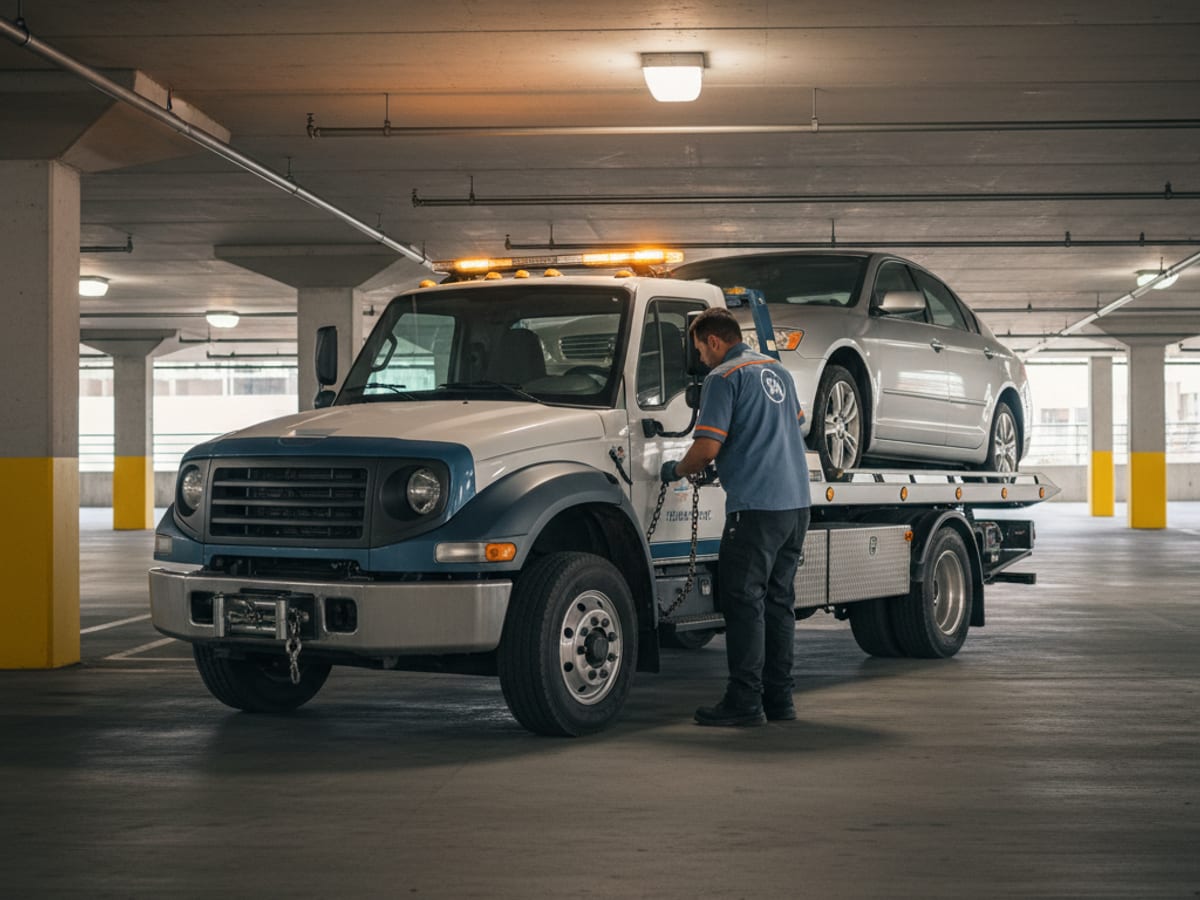
A licensed tow operator can tow a car without keys. Standard methods are flatbed, wheel-lift with dollies on the drive wheels, or a wheel-lift with the parking brake released by the operator. For parking garages and apartment lots in Houston, the operator typically uses dollies because the cars are usually driveable otherwise but the keys are inside a locked unit or simply missing.
Why a car might need to be towed without keys
Common situations:
- Keys locked inside the car
- Keys lost and a duplicate is on order
- Car is being repossessed (lender has the keys, you do not)
- Car is being towed from a private lot for non-payment of storage
- Car is being moved at the property owner’s request (sale, repossession, HOA enforcement)
- Car has been abandoned at a property
In each case, the operator’s standard tools handle a keyless tow.
What method the operator uses
The operator picks a method based on the car and the location:
- Flatbed: the car is loaded onto the flatbed. No need for keys or to release the parking brake. The safest option for any vehicle.
- Wheel-lift with dollies: the drive wheels are placed on dollies (small rolling platforms). The non-drive wheels are lifted. The car rolls on the dollies.
- Wheel-lift with brake release: the operator accesses the parking brake release (usually a cable under the dashboard or a tool in the wheel-well area) to disengage the brake. Then the wheel-lift lifts and tows.
- Skates: heavy-duty rollers placed under the tires to push the car to a lift or flatbed location. Common in tight parking garages.
For a Tesla or other EV, see our Tesla towing guide. The operator uses flatbed only and may need to put the car in Transport Mode.
What if the parking brake is stuck
Some cars have a stuck parking brake (the cable freezes, the caliper seizes, the electronic brake fails to release). The operator has tools for this:
- Manual brake release (usually accessible from under the car or inside the wheel well)
- Dolly method (the brake stays engaged but the car rolls on the dollies)
- Flatbed (the brake is irrelevant once the car is on the flatbed)
A stuck brake does not stop a tow. The operator just picks a different method.
What about a locked steering wheel
A locked steering wheel (the wheel does not turn) usually means the key is not in the ignition. For a tow, this is irrelevant, the wheel-lift or flatbed does not need the steering wheel to turn. The operator tows the car in whatever position the wheels are in.
If the car ends up needing to be moved once parked at the VSF, the operator uses a steering wheel unlock tool (a tool that fits the keyway and applies torque) or dollies again.
What about a dead battery
A dead 12V battery (especially common in Teslas and other EVs) means the parking brake may be stuck in the engaged position (electronic parking brake needs 12V power to release). The operator:
- Jump starts the 12V from a portable pack
- Releases the parking brake electronically
- Proceeds with the standard tow
If the operator cannot access the 12V terminals or the jump does not work, the operator flatbeds the car without the brake released.
What about access issues in a parking garage
Houston parking garages have height limits (often 6 to 8 feet), tight turns, and narrow lanes. For keyless cars in tight garages:
- Skates (rollers) work well to push the car to a lift or ground-floor exit
- Wheel-lift is too tall for many garages (the boom needs clearance)
- Flatbed is too tall for most garages
- The operator typically uses skates for the garage portion and a flatbed or wheel-lift on the ground floor
For an apartment lot (open lot, not a garage), the operator uses standard tools.
How much it costs
The tow is quoted on the call before the truck rolls. Keyless cars usually cost the same as key cars (the operator’s tools are standard). The fee is based on the vehicle class, location, and destination.
For City of Houston non-consent tows, the rate is $232 for the first 20 miles, then $4.64 a mile under Mun. Code §8-123. For private-property tows, the operator quotes a fee. For consent tows, the operator quotes a fee.
How to dispatch a tow for a keyless car
Call Quick Tow Houston at (281) 916-1288. Tell the operator:
- The car class (sedan, SUV, pickup, etc.)
- The reason for the tow (locked out, repossession, lot removal, etc.)
- The location (lot, garage, street)
- Any access issues (height limits, narrow lanes, stairs)
The operator dispatches the right equipment.
For what the operator charges, see our tow cost guide. For Tesla-specific flatbed requirements, see our Tesla guide.
Frequently asked questions
Can a tow truck take a car without keys? Yes. Standard tow methods (flatbed, wheel-lift with dollies, skates) handle a keyless car without damaging the steering or drivetrain.
What if the parking brake is engaged? The operator uses dollies, releases the brake manually, or flatbeds the car. The brake does not stop the tow.
What if the car is in a parking garage? The operator uses skates (rollers) inside the garage and a flatbed or wheel-lift on the ground floor. Height limits usually rule out flatbed and wheel-lift inside the garage.
Can the operator force the steering wheel to turn? For a tow, the operator does not need the steering wheel to turn. For moving the car after tow, the operator uses a steering wheel unlock tool or dollies.
What if my Tesla has no 12V power? The operator jump-starts the 12V from a portable pack, releases the parking brake, and proceeds with the tow. Flatbed is the fallback.
Is it more expensive to tow without keys? Usually no. The operator’s tools are standard. The fee is based on the vehicle class and location, not the key status.