A breakdown near Conroe leaves you with two immediate decisions. You need to describe your location, then choose roadside help or towing. If you’re searching for automobile towing Conroe TX, start by identifying your side of I-45 and the car’s condition.
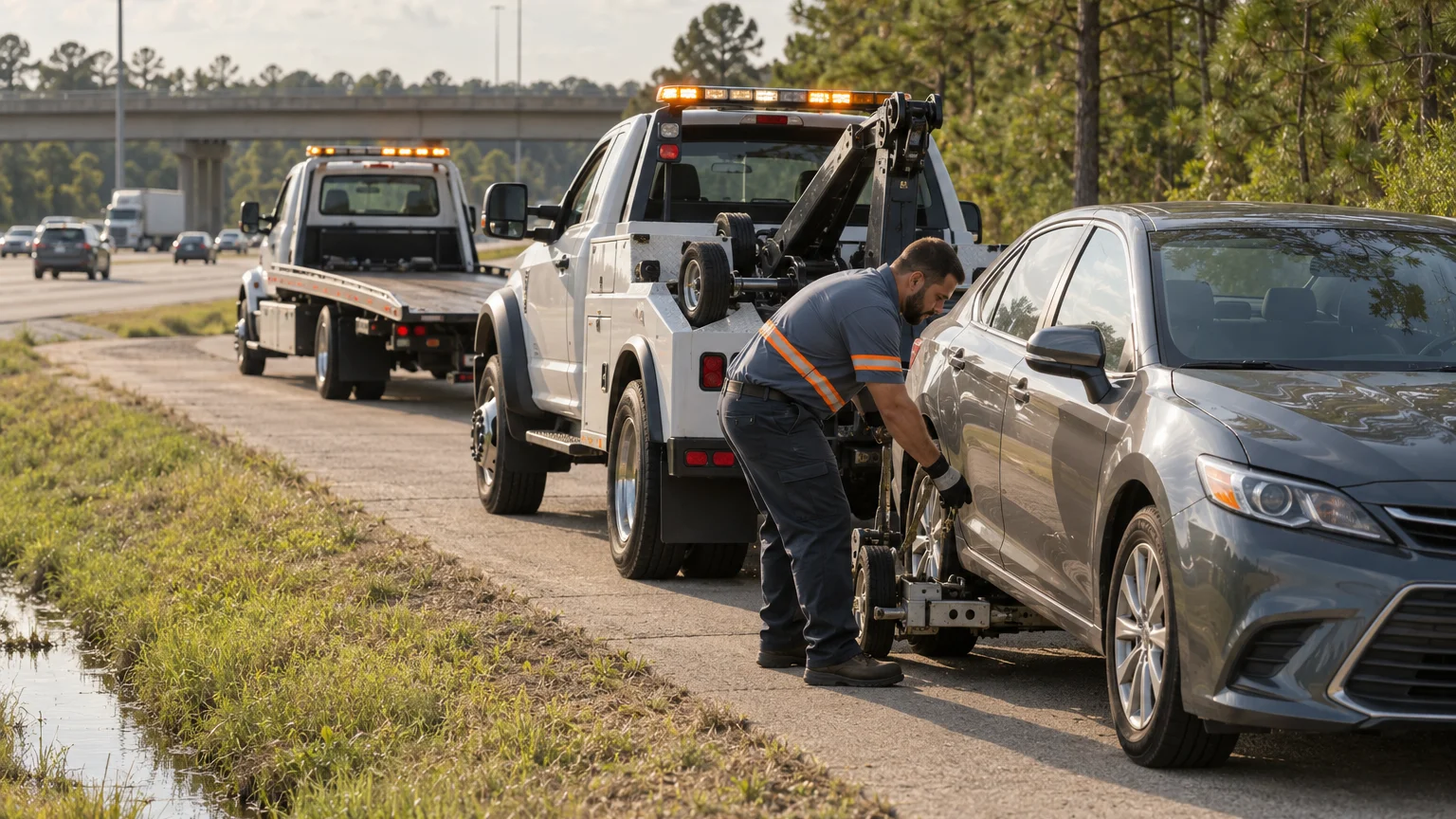
Describe which side of I-45 you’re on
“I-45 near Conroe” isn’t enough for an accurate dispatch. The operator needs your direction, roadway, and nearest visible reference. Begin with northbound or southbound. Then say whether you’re in the main lanes, on a shoulder, or beside the frontage road.
Check your phone’s map pin if you can do so safely. Read the nearest road, exit, overpass, or business name from the map. Don’t rely only on the city label. A map may display Conroe while your position is closer to Shenandoah or The Woodlands.
Tell dispatch whether you passed the landmark or haven’t reached it. “Southbound, just past the overpass” is clearer than “near the overpass.” Mention whether the vehicle is before or after an entrance ramp. That detail can change how an operator approaches you.
Also describe what the driver will see. Note your automobile’s color, body style, and visible position. Say whether it’s fully away from traffic or still occupying a traveled lane. If the vehicle is in immediate danger, contact emergency services first.
Texas law addresses stopping on the main traveled portion of a highway outside business or residential districts. It generally prohibits stopping there unless pulling away isn’t practical, a clear passing lane remains, and the vehicle is visible from both directions. Disabled vehicles are excepted. Don’t attempt to move a vehicle when doing so would create another hazard.
Once your position is clear, emergency towing dispatch can connect you with a licensed, insured operator. Ask that operator for an arrival estimate based on the actual location.
Freeway shoulder and frontage-road differences
A main-lane breakdown isn’t the same job as a frontage-road pickup. Traffic position affects access, loading, and communication. Tell dispatch exactly where the vehicle stopped before discussing the mechanical problem.
On a shoulder, identify which side of the roadway you’re beside. “Northbound right shoulder” gives the operator more useful information than “on I-45.” Mention barriers, narrow pavement, ramps, or blocked access that you can see. Don’t guess the shoulder’s width or promise that a truck can fit.
A frontage-road stop usually gives the driver a different approach. Still, frontage roads can split, turn, or feed directly into entrance ramps. Share the nearest cross street and your direction of travel. If you’re in a parking lot, provide the entrance you’re closest to.
Your location can also affect whether a public freeway assistance program applies. Houston’s Tow and Go program covers qualifying attended vehicles when assistance is authorized by law enforcement or Houston TranStar. It provides a tow to a safe place off the freeway, generally up to about one mile, or a tire change with a working spare. Tollways and Katy Freeway HOT lanes are excluded.
Don’t assume a breakdown near Conroe qualifies for that Houston program. Its eligibility outside Houston couldn’t be confirmed from the approved information for this page. Check the official program page or follow instructions from the responding public agency.
For more context on freeway calls farther south, read our guide to towing on Houston freeways. Your operator still needs the precise pickup point before heading toward I-45.
Roadside help or towing for the next move
The right request depends on what failed and what happens next. A simple roadside service may be enough when the automobile can safely continue after assistance. Towing makes more sense when the car can’t be driven or its condition is uncertain.
Start with what you observed. Tell dispatch whether the engine stopped, the car won’t start, a tire is damaged, or warning lights appeared. Mention smoke, leaking fluid, collision damage, steering trouble, or a wheel sitting at an unusual angle. Don’t diagnose the cause unless you know it.
A working spare may make a tire-service request possible. A battery problem may call for a jump-start assessment. Running out of fuel points toward delivery rather than transport. Our roadside assistance service explains the types of calls we can route to operators.
Some symptoms should be described without attempting another start. Smoke, a strong fuel odor, major fluid loss, or crash damage can change the equipment and handling plan. Let the operator decide what service fits the condition you report.
If you’re unsure, say that plainly. A wrong diagnosis can send an operator without the setup needed for the automobile. Photos may help when the operator requests them, especially for wheel damage or an unusual parking position.
Roadside help should lead to a clear next step. If the repair can’t be handled where the car stopped, towing avoids repeated service calls. The operator can explain whether the reported condition requires transport. For a broader comparison, see roadside assistance or a tow truck.
The operator sets the service price. Ask what information the quote covers before dispatch, including pickup conditions and destination.
Conroe, Shenandoah, and The Woodlands destinations
Choose a destination before the operator loads the automobile when possible. That choice controls the route and helps the operator quote the requested trip. It also prevents a stressful decision after the vehicle is already secured.
Conroe may be the practical destination when your home, repair shop, or dealership is north of the breakdown. Shenandoah or The Woodlands may fit a southbound driver who stopped before reaching Houston. The nearest city name isn’t automatically the right destination.
Call the repair facility yourself before selecting it. Confirm that it accepts your automobile, can receive a tow, and has instructions for vehicle access. Business hours, after-hours procedures, and repair availability couldn’t be confirmed for individual destinations here. The facility itself is the authority for those details.
If the vehicle is under a dealer warranty or roadside plan, ask the plan administrator where it may be taken. Don’t assume every repair shop handles your make, an electric vehicle, collision damage, or a locked automobile.
You can also request transport to a home or another lawful drop-off point. Describe the destination’s access. Gates, parking garages, narrow drives, steep approaches, and property rules can affect unloading. The operator must decide whether the location is workable.
Distance matters, but it isn’t the only consideration. A closer shop that can’t accept the vehicle creates another problem. A confirmed destination reduces the chance of a second tow. Our guide to choosing a dealership or repair shop destination can help you compare the options.
Quick Tow Houston doesn’t own a yard or impound lot. We dispatch your request to an operator, and you contract directly with that operator.
What the operator confirms before heading out
A clear intake gives the operator a usable picture of the call. Expect questions about the pickup, vehicle, condition, destination, and access. Give short, exact answers and correct anything that changed.
The operator may need:
- Your northbound or southbound direction
- Main lanes, shoulder, frontage road, or parking lot
- The nearest road, exit, overpass, or map pin
- The automobile’s year, make, model, and body type
- Whether the wheels roll and the steering works
- Visible collision, tire, wheel, or suspension damage
- Keys, parking position, and destination access
- Your requested destination in Conroe, Shenandoah, or The Woodlands
Mention modifications, low ground clearance, all-wheel drive, electric power, or missing keys. The operator decides what equipment and loading method fit the vehicle. Quick Tow Houston doesn’t own trucks or select equipment independently.
Confirm the service price directly with the operator before the truck rolls. Quick Tow Houston doesn’t set towing rates. The amount can depend on the service, vehicle, access, pickup conditions, and destination.
Texas requires tow operators to hold a license from the Texas Department of Licensing and Regulation. The state recognizes Incident Management, Private Property, and Consent Tow licenses. You can review consumer information and verify licensing through the TDLR towing resources.
A voluntary breakdown tow is different from a non-consent removal. Don’t use published government caps as a quote for your requested trip. Ask the operator which service is being arranged and what the quoted price includes.
Keep your phone available after dispatch. Road position can be difficult to interpret from a pin alone. If your automobile moves or public authorities direct you elsewhere, update dispatch with the new location.
When to call us
Call when your automobile can’t continue safely, roadside service won’t solve the problem, or the vehicle needs transport from I-45 near Conroe. Call us at (281) 916-1288 and we’ll connect you with an operator who handles this work.