A stalled passenger car near Pasadena’s Ship Channel roads needs the right kind of help. Your location, the car’s condition, and its destination help determine whether the operator brings roadside equipment or prepares for a tow.
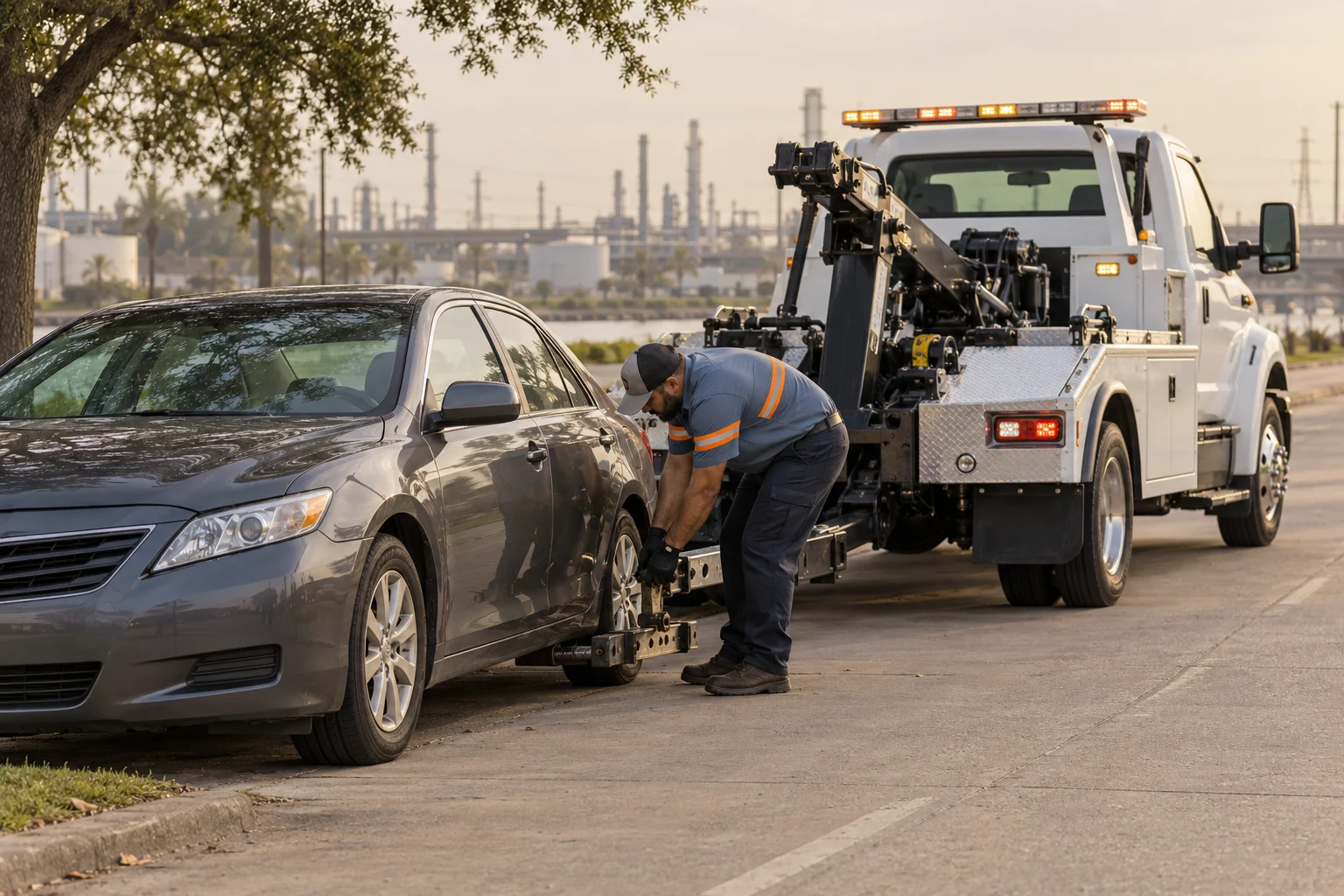
Send the road, direction, and nearest landmark
Start with the road name and your direction of travel. “Near Pasadena” covers too much ground for an operator to find you efficiently. Say whether you’re on SH 225, Beltway 8, a frontage road, or a local street.
Then provide the nearest cross street or visible landmark. A business name, driveway entrance, building number, or mile marker can narrow the location. If your phone shows a map pin, share it with the operator. Confirm that the pin matches where the car actually stopped.
Direction matters on divided roads. An operator approaching the opposite side may need another route to reach you. State which way the car was traveling before it stopped. Also mention whether you’re in a traffic lane, parking area, driveway, or roadside position.
Pasadena, Deer Park, and Channelview sit within a dense mix of residential, commercial, and industrial roads. A location described only as “by the Ship Channel” isn’t specific enough. Tell dispatch which city appears on your map and which nearby road you can identify.
Texas law limits stopping on the main traveled part of a highway outside business or residential districts, except in situations that include disabled vehicles. Don’t attempt to move a car when doing so would create another problem. Follow instructions from law enforcement when officers are managing the scene.
When you contact us for emergency towing, we’ll route the location details to an operator. Ask that operator for an arrival estimate, since road access and truck availability can change.
Describe whether the car can roll or steer
The operator needs more than the car’s make and model. Explain whether it rolls, steers, starts, and shifts into neutral. These details affect how the vehicle can be loaded.
Say which wheels appear blocked or damaged. Mention a flat tire, broken suspension, collision damage, leaking fluid, or a wheel that sits at an unusual angle. Don’t guess at the mechanical cause. Describe what you can observe without crawling beneath the car.
Tell the operator where the keys are. If the keys are missing, locked inside, or won’t turn, say that during intake. A car that can’t shift into neutral may require a different loading approach. Our guide to towing a car that won’t shift into neutral explains why that detail matters.
Also identify the vehicle accurately. Give the year, make, model, and body style when known. Say whether it’s an electric vehicle, an all-wheel-drive car, or a modified vehicle. The operator decides which equipment fits the car and its condition.
Passenger cars shouldn’t be described as heavy-duty calls just because they stopped near industrial traffic. Heavy trucks, buses, and loaded commercial vehicles require different planning. Those situations belong in our guide to heavy-duty towing around Houston’s Ship Channel.
Clear details reduce back-and-forth after dispatch. They also let the operator flag access concerns before heading toward the vehicle.
Choose roadside help or vehicle transport
Not every breakdown requires vehicle transport. A working spare tire, a discharged battery, an empty fuel tank, or keys locked inside may point toward roadside assistance. The operator still needs to confirm that roadside work fits the car’s condition and location.
A tow is usually the clearer request when the car can’t run, steer, roll, or remain where it stopped. Collision damage and major mechanical symptoms also give the operator important context. Don’t restart a vehicle when you’ve been told that doing so could worsen known damage.
Tell dispatch what happened immediately before the stop. Useful descriptions include a warning light, sudden loss of power, overheating indication, impact, grinding sound, or tire failure. Avoid diagnosing the problem unless a mechanic has already identified it.
If you aren’t sure which service fits, explain the symptoms. We’ll connect you with an operator who can discuss roadside help or transport. The operator performing the work sets the price, so confirm the service and charge directly before dispatch.
There isn’t an approved statewide “fair price” for a voluntary passenger-car tow. Distance, vehicle condition, access, and destination can affect the operator’s quote. The published figures that do exist cover regulated non-consent situations, not ordinary requested towing.
For a non-consent tow, TDLR lists statewide maximum charges. The approved cap for a vehicle weighing 10,000 pounds or less is $272. The approved drop fee is $135, and the notification fee is $50. These are government-set limits, not Quick Tow Houston prices.
If paying for transport is a concern, discuss that before the operator rolls. Ask what service is being proposed, what the operator will charge, and which payment methods the operator accepts.
Pasadena, Deer Park, and Channelview destinations
Choose a destination before requesting transport when possible. Common choices include a repair shop, dealership, home, or another place authorized to receive the car. The right answer depends on what happened and what the destination will accept.
A repair shop may be useful when the car needs diagnosis. Confirm that the shop accepts incoming vehicles and knows yours is coming. Ask where a tow operator should leave it if no staff member will meet the vehicle.
A dealership may fit warranty work, recalls, or brand-specific service. The dealership decides what it accepts. Call first and confirm the correct entrance or drop location.
Home can be practical when you need time to choose a repair facility. It may also create a second tow later. Our guide to deciding whether to tow a car home or to a repair shop walks through that choice.
Tell the operator whether the destination is in Pasadena, Deer Park, Channelview, or elsewhere in the Houston area. Don’t assume two nearby addresses fall under the same jurisdiction or access conditions. Route length and road access can differ even when both places are east of central Houston.
If the car was removed without your consent, this becomes a vehicle-location issue instead of a breakdown dispatch. The approved research doesn’t confirm one Pasadena-specific lookup process. Check the posted towing sign, contact the property representative, or ask the applicable local authority how to locate the vehicle.
The City of Houston tow lookup applies to City of Houston tows. Don’t assume it covers a removal handled by Pasadena or another jurisdiction. Houston also uses a network of licensed private storage facilities, not one city impound lot.
Confirm access and destination with the operator
Ship Channel-area roads can lead to public streets, private lots, controlled industrial property, and loading areas. The approved research doesn’t establish one access rule for every Pasadena, Deer Park, or Channelview property. Confirm the location with the property contact, applicable authority, and operator.
Tell the operator about gates, guards, building entrances, parking structures, tight turns, or blocked driveways. Share only conditions you can verify. Don’t promise that an operator can enter a site until the person controlling that property approves access.
If the car stopped inside an employer’s or contractor’s property, contact the site representative. Ask where the operator may enter and whether someone must meet the truck. The property sets its own access process, and those requirements could not be confirmed for every Ship Channel-area facility.
Confirm the destination address character by character. Similar business names and multiple entrances can cause confusion. Give the operator a contact name when someone will receive the vehicle. If nobody will be present, ask the destination what instructions it requires.
Before dispatch, review the vehicle description, pickup point, destination, and requested service. Ask the operator to explain the proposed equipment when the car has wheel, steering, or collision damage.
Texas requires tow operators to hold a TDLR license. You can verify an operator through the license search linked from TDLR’s towing resources. The licensed, insured operator we connect you with performs the work, and you contract directly with that operator.
If your stopped vehicle is on an eligible Houston freeway, the city’s Tow and Go program may provide a no-cost tow to a safe place off the freeway, up to about one mile. It excludes tollways and Katy Freeway HOT lanes. The vehicle must be attended, and law enforcement or Houston TranStar must authorize the tow. A requested tow to your home or another destination falls outside that basic freeway-clearance service.
When to call us
Call when your passenger car needs roadside help or transport near Pasadena, Deer Park, or Channelview. Call us at (281) 916-1288 and we’ll connect you with an operator who handles this work.