A breakdown near Pearland can leave you between several roads and jurisdictions. When requesting roadside assistance in Pearland, TX, your first decisions are location, service type, and destination.
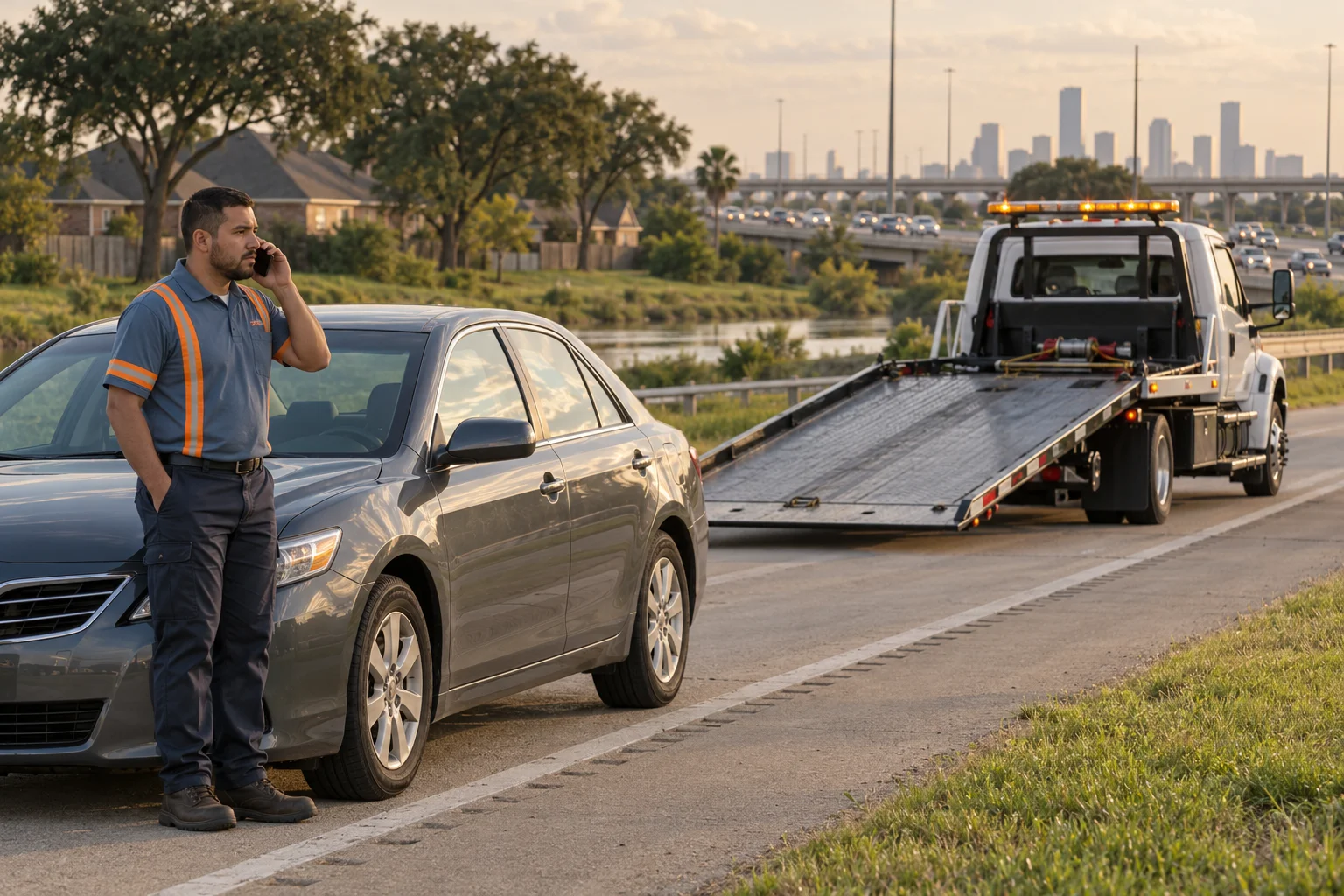
Share your direction and nearest confirmed location
Start with details that separate your location from similar places nearby. “Near Beltway 8” covers too much ground for an operator to act on alone. The same applies to “by the Gulf Freeway.”
Share the road name, direction, and nearest confirmed cross street or exit. Say whether you’re on the main lanes, a frontage road, or nearby property. If you entered a parking lot, provide the business name and visible street address. Your phone’s map pin can help, but describe what you see too.
A useful location description might include:
- Eastbound or westbound travel on Beltway 8
- Northbound or southbound travel near the Gulf Freeway
- The nearest exit number or overhead sign
- A cross street such as Pearland Parkway or Broadway Street
- Whether you’re north or south of the Beltway
- A parking-lot entrance, building number, or recognizable storefront
- The vehicle’s color, model, and visible position
Don’t guess at an exit or intersection. Tell the dispatcher which details came from a sign, map, or address. If your map shows Pearland while a nearby sign shows Houston, share both. City limits and road jurisdictions can affect which guidance applies.
Also explain how the vehicle is positioned. An operator needs to know whether it’s in a marked parking space, beside a curb, on a frontage road, or obstructing travel. This isn’t the time to diagnose the entire car. Accurate access details matter more.
Quick Tow Houston uses this information to route your request. The operator still confirms availability, access, and the service plan directly with you.
Decide whether the vehicle needs roadside help
Roadside help makes sense when the problem may be handled where the vehicle sits. A tow is more appropriate when the vehicle can’t be returned to usable condition there. The operator should make the final service decision after hearing the symptoms and location.
Describe what happened without naming a repair you can’t confirm. Useful details include whether the engine turns over, warning lights appeared, a tire is damaged, keys are inaccessible, or the fuel gauge reads empty. Mention collision damage, leaking fluid, smoke, unusual wheel position, or contact with a curb.
Our roadside assistance service can connect you with an operator for issues such as a possible jump start, lockout, tire problem, or fuel request. Confirm the exact service with that operator before dispatch. Roadside assistance doesn’t automatically mean every problem can be fixed beside the road.
Fuel delivery is one example. Tell the operator what the gauge shows and where the vehicle stopped. Ask whether fuel delivery is available at that location. Don’t assume a roadside plan, insurance benefit, or membership covers the request. Those terms come from the company that issued the plan.
A battery symptom can also hide another problem. If a jump doesn’t fit the symptoms, the vehicle may need transport. Tire damage may require towing when there’s no usable spare or the wheel has additional damage. Our guide to choosing roadside assistance or a tow truck explains that decision in more detail.
If the car can’t be moved under its own power, tell the operator. Don’t attempt a roadside repair that requires professional equipment. The operator can explain whether roadside service or towing fits the situation.
Choose a Pearland or Houston destination
Decide where the vehicle should go before the operator arrives, when possible. A clear destination lets the operator check distance, access, and whether the requested trip fits the available service.
You might choose your home, a repair shop, a dealership, or another property where the vehicle can legally remain. The right choice depends on what happens next. A home destination may help when you need time to arrange repairs. A shop may be better when it has agreed to inspect the vehicle.
Call the destination before confirming the tow. Ask whether it accepts the vehicle, where it should be left, and whether someone must receive it. Don’t assume a closed lot permits an unattended drop. Gate access, garage height, parking rules, and key handling should be settled with the destination and operator.
Location matters around Pearland. A destination near central Pearland isn’t the same trip as one north of Beltway 8 in Houston. A shop near SH 288 can create a different route than one near Pearland Parkway or the Gulf Freeway. Give the full address, not only the business name.
If you’re deciding between two locations, share both addresses with the operator. The operator sets the price and should quote the selected trip before the truck rolls. Quick Tow Houston doesn’t set towing rates.
Our guide on whether to tow a car home or to a repair shop can help you compare those choices. Confirm the final destination before pickup. Changing it after loading can alter the route, access needs, and operator’s price.
Beltway 8 and Gulf Freeway location details
A car breakdown near Beltway 8 can be easy to misplace. Drivers may mean the main lanes, a frontage road, an entrance ramp, or a nearby business. State which one applies. Include your direction of travel and the last confirmed exit.
The Gulf Freeway is the I-45 corridor south of Houston. If you’re near its connection with Beltway 8, don’t rely on “near I-45” as the complete location. Say whether you’re approaching or leaving the interchange. Name the roadway you’re physically on.
For a Pearland-area request, these details reduce confusion:
- Which side of Beltway 8 you’re on
- Whether you’re closer to SH 288 or the Gulf Freeway
- Whether the map places you in Pearland or Houston
- The nearest readable exit, cross street, or business address
- Whether the vehicle is on main lanes, frontage road, ramp, or private property
Don’t invent toll-road procedures based on the road name. Check current instructions from the authority responsible for your exact location. Tell the operator if you’re on a tolled main lane, but let the operator confirm access and the next step.
Houston’s Tow and Go program offers certain assistance for an attended disabled vehicle on eligible Houston freeways. The approved program information says it can move a vehicle to a safe spot off the freeway and can change a flat tire when there’s a working spare. Tollways and Katy Freeway HOT lanes are excluded.
That doesn’t confirm eligibility for every Pearland or Beltway 8 location. Check the current program page and identify your exact roadway first. If you request transport to a home or other destination, discuss that trip directly with the towing operator.
Confirm access and service with the operator
Before dispatch, confirm what the operator understands. Repeat the pickup point, vehicle description, reported problem, and requested destination. Correct any detail that came from an uncertain map result.
Ask the operator whether the location is accessible. Mention parking-garage clearance, locked gates, narrow driveways, damaged wheels, trailers, modifications, or collision damage. These details can change what kind of towing setup fits the job. The operator decides what equipment is required.
Confirm these points directly:
- The operator’s understanding of your exact pickup location
- Whether roadside work or towing is planned
- The complete destination address
- Property access at pickup and drop-off
- The operator’s price before dispatch
- Any limits affecting the requested service
- An arrival estimate based on current operator availability
Quick Tow Houston dispatches and refers your request. We don’t own trucks, employ tow operators, or perform roadside work. You contract directly with the licensed, insured operator who accepts the job.
Texas requires tow operators to hold the appropriate TDLR license. You can review state towing information through the Texas Department of Licensing and Regulation. Confirm the individual operator’s current license through TDLR’s license search before service if you need verification.
If the vehicle needs transport rather than roadside work, we can connect you with an operator handling emergency towing. That service label doesn’t guarantee local availability or a specific response time. Ask the operator for the current arrival estimate after the location and job are accepted.
Keep your phone available after dispatch. If your position changes, tell the operator immediately. A different frontage road, parking entrance, or side of the interchange can send the truck toward the wrong access point.
When to call us
Call when roadside service can’t resolve the problem, the vehicle can’t be driven, or a licensed towing operator needs to move it. Call us at (281) 916-1288 and we’ll connect you with an operator who handles this work.