A disabled RV can leave two vehicles and one difficult decision. You need to identify what failed, what must move, and where it can go. If you’re searching for a “5th wheel RV towing service near me,” start by gathering the unit specifications before calling dispatch.
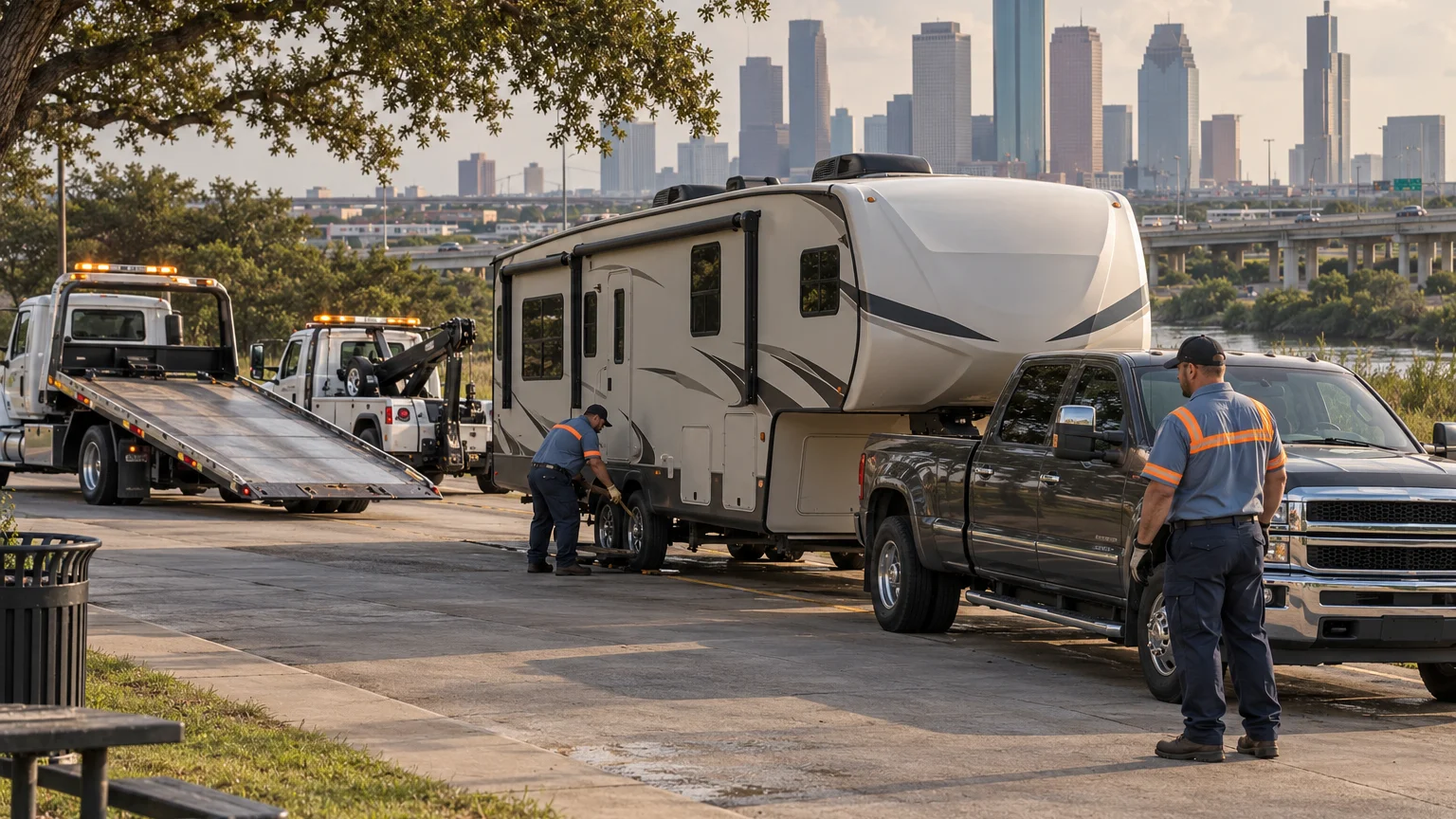
What broke and which unit needs to move
First, determine whether the problem involves the RV, its tow vehicle, or both. That distinction changes the request you’ll make to dispatch.
A fifth-wheel setup includes a trailer and a separate tow vehicle. The truck may be disabled while the trailer remains intact. The trailer may instead have wheel, axle, suspension, hitch, or body damage. Sometimes both units need separate arrangements.
A motorhome is different because its living space and driving components share one vehicle. Tell dispatch whether the motorhome starts, rolls, steers, and brakes. Don’t attempt repairs or movement when the unit’s condition makes that unsafe.
Describe what happened without diagnosing anything you can’t confirm. Useful details include:
- Which unit is disabled
- Whether either unit can move under its own power
- Visible damage, leaking fluids, smoke, or unusual wheel positions
- Whether the RV is upright and on pavement
- Whether it’s blocking traffic, a driveway, or a campsite lane
- The requested destination for each unit
Photos can help an operator understand the scene. Capture the whole combination, damaged areas, wheel positions, hitch area, and surrounding access. Stay away from moving traffic while taking them.
Our RV and trailer towing service connects callers with licensed, insured operators. We dispatch and refer the job. The operator determines whether the unit can be moved and what equipment the work requires.
If you’re unsure how to describe your Houston location, review our guide to finding a tow truck near you in Houston. Cross streets, travel direction, and a visible landmark are more useful than a broad neighborhood name.
Motorhome, fifth-wheel, and travel-trailer differences
“RV” can describe several very different vehicles. Dispatch needs the specific type, not just the general term.
A motorhome moves as one powered unit. A fifth-wheel is a separate trailer connected to a tow vehicle. A travel trailer is also separate, but its connection differs from a fifth-wheel setup. Don’t assume one operator or equipment arrangement fits every category.
Provide the year, make, model, and identification details you can read safely. The manufacturer’s documentation may list dimensions and weight information. Share those specifications exactly rather than estimating them.
For a fifth-wheel breakdown, explain the condition of both the pickup and trailer. If the pickup still runs, don’t assume it can continue pulling the trailer. Visible hitch damage, a shifted trailer, or problems near the wheels need an operator’s review.
For a motorhome, report the body style and number of axles. Also mention attached items, including a tow car, trailer, cargo rack, or exterior equipment. The operator needs the full combination, not only the main vehicle.
A travel trailer call should include information about the trailer and tow vehicle. Tell dispatch whether they remain connected. Don’t disconnect, reconnect, or reposition anything unless the responding operator says it’s appropriate.
Some RV calls may require an operator who handles heavy-duty towing. Quick Tow Houston doesn’t select equipment based on a caller’s guess. We collect the details and route the request to an operator who can evaluate it.
Texas requires tow operators to hold a TDLR license. You can review towing information and verify licensing through the Texas Department of Licensing and Regulation.
Clearance, weight, and access details dispatch needs
RV dimensions matter before an operator enters the property or approaches the unit. Give dispatch the manufacturer’s listed specifications whenever possible. Don’t estimate height, length, or weight from appearance.
Start with the complete dimensions of the disabled unit. If a pickup and fifth-wheel remain connected, say so. Tell dispatch whether slide-outs, awnings, steps, antennas, or other parts are extended or damaged.
Next, describe the access point. Houston-area RV breakdowns don’t always happen on open pavement. The unit may sit inside a storage property, RV park, repair yard, fuel station, or gated subdivision.
Mention these access conditions:
- Gate width and overhead clearance
- Tight turns, parked vehicles, or low branches
- Gravel, mud, grass, soft shoulders, or standing water
- Covered parking or low structures
- Steep entrances or uneven ground
- Locked gates or property access restrictions
- Space available in front of and behind the RV
Don’t claim a unit’s weight unless you have a reliable specification. Look for the manufacturer’s label, owner documentation, or model information. Send a clear photo if the label is accessible without entering traffic or crawling beneath the unit.
Dispatch also needs to know whether wheels appear damaged or missing. Report any visible issue without trying to test the component. An operator may request more photos before accepting the job.
Location details should be precise. “Near Katy” could mean an I-10 frontage road, an RV park, or a rural property west of the city. “Near Pasadena” could place the unit beside local traffic or closer to the Ship Channel area. Those scenes have different access limits.
The operator decides what equipment is suitable. Confirm that decision before the truck is sent, especially when the RV’s specifications or access conditions remain unclear.
I-10, I-45, and Gulf Coast travel routes
Houston RV traffic spreads across long corridors. Your direction of travel can be as important as the nearest city name.
West of Houston, I-10 connects the Energy Corridor, Katy, and routes continuing across Texas. Inside the metro, the Katy Freeway becomes especially wide near Beltway 8. Tell dispatch whether you’re on the main lanes, frontage road, ramp, or nearby property.
I-45 carries travelers north through Houston and south toward the Bay Area and Galveston. A breakdown near Downtown isn’t the same request as one near Clear Lake or farther toward the coast. Include your direction, closest exit, and the last sign you passed.
East of Houston, I-10 leads toward Channelview and Baytown. Nearby routes also serve Pasadena, Deer Park, Galena Park, and the Ship Channel area. Industrial entrances, security gates, and restricted access can affect where an operator meets you. Tell dispatch if the unit is inside a controlled property.
For any freeway breakdown, move away from traffic if you can do so safely. Don’t stand between the RV and passing vehicles. Outside a business or residential district, Texas generally restricts stopping on the main traveled portion of a highway unless pulling off isn’t practical and other statutory conditions are met. Disabled vehicles are excepted under Texas Transportation Code §545.301.
Houston’s Tow and Go program offers certain assistance for attended disabled vehicles on eligible freeways. It excludes tollways and the Katy Freeway HOT lanes. The program’s basic tow moves an eligible vehicle to a safe location off the freeway. Check the current terms through Houston Tow and Go rather than assuming an RV combination qualifies.
A destination outside the Houston area needs separate planning. Our guide to long-distance tow costs from Houston explains what to confirm without presenting an operator’s price as ours.
Confirming equipment, destination, and cost with the operator
A tow truck may be able to move a fifth-wheel camper, but there isn’t one answer for every unit. The operator must review the trailer specifications, condition, access, and destination before confirming the job.
Ask the operator to identify which unit the arrangement covers. A disabled pickup and attached fifth-wheel may require different handling than an undamaged trailer waiting at a campsite. If two units need transport, confirm whether both are included.
You should also confirm:
- The exact pickup location
- The exact destination
- Which vehicle or trailer will be moved
- Whether the operator has reviewed the manufacturer’s specifications
- Whether photos or additional measurements are required
- What must be disconnected, secured, or removed
- Who will handle any separate tow vehicle
- The operator’s price and payment terms
Quick Tow Houston doesn’t set the operator’s price. The customer contracts directly with the operator performing the work. Ask the operator for the cost before dispatch and confirm what that amount covers.
No verified standard price for moving a fifth-wheel camper appears in the approved Houston claims ledger. The figure must come from the operator reviewing your specific job. Don’t rely on a generic online estimate.
For an interstate move, give the complete destination address and disclose every state the route may enter. Ask the operator to confirm that the proposed transport and price cover the full trip. Quick Tow Houston can’t publish a general interstate price or promise that every operator accepts those jobs.
Before pickup, confirm whether the repair shop, RV dealer, storage property, or campground can receive the unit. Ask the destination about gate access, clearance, check-in requirements, and where the RV should be placed. We can’t confirm those property rules for you.
If conditions change before arrival, tell the operator. A moved vehicle, locked gate, rising water, or newly discovered damage may change the plan.
When to call us
Call when a disabled motorhome, fifth-wheel, or travel trailer needs professional transport near Houston. Have the unit specifications, photos, location, and destination ready for dispatch.
Call us at (281) 916-1288 and we’ll connect you with an operator who handles this work.