A car that won’t start leaves you with one immediate decision. Request a jump start first when the problem appears battery-related. Request a tow when the car still won’t run, can’t be reached safely, or needs inspection elsewhere.
Quick Tow Houston dispatches and refers callers to licensed, insured local operators. The operator determines whether a jump start fits the situation. If it doesn’t, we can connect you with someone who can move the vehicle.
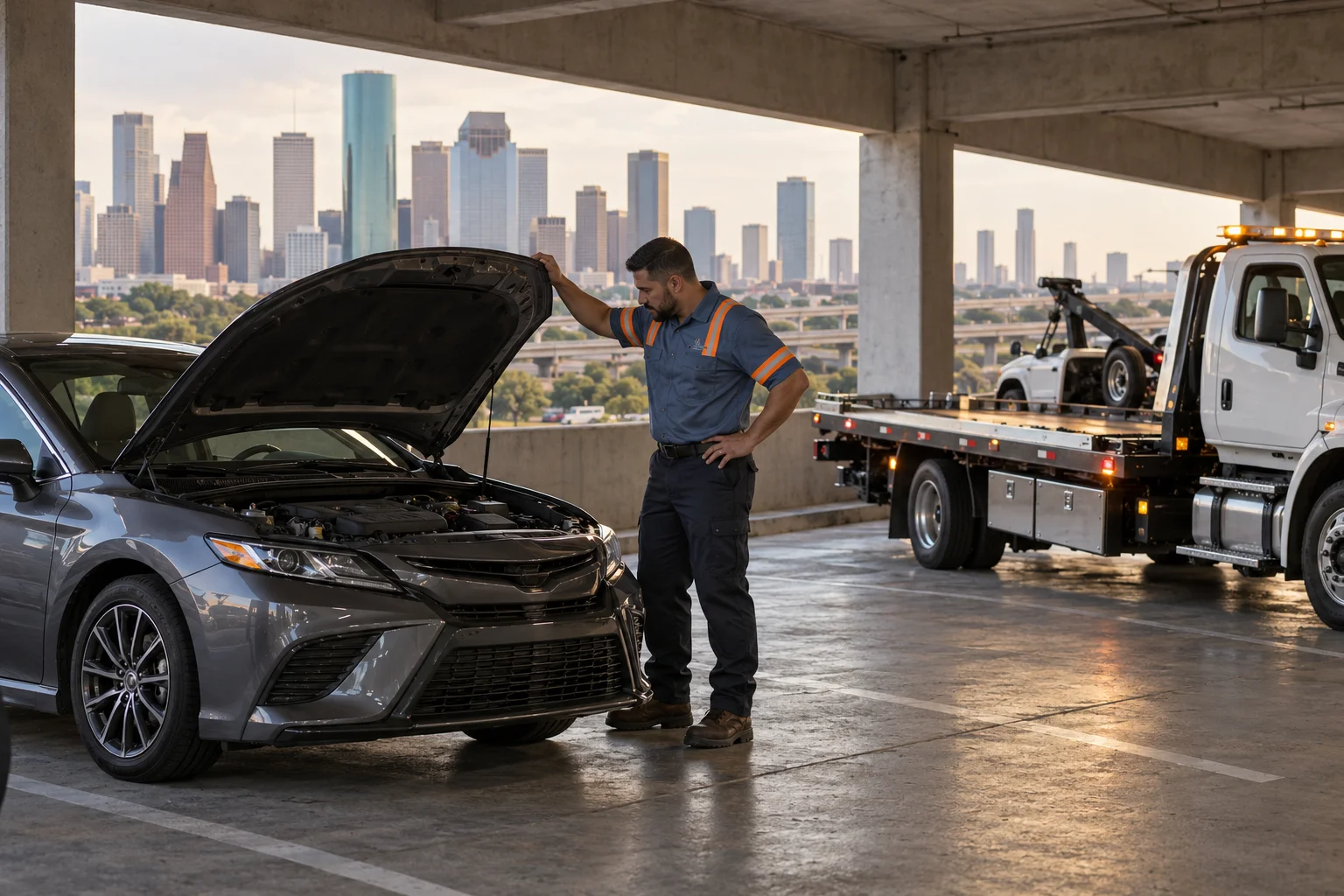
When a jump start may get the car moving
Searching for a “jump start near me” usually means the car is parked and won’t start. The dashboard may be dark, lights may appear weak, or the engine may not respond as expected. Those observations help the operator, but they don’t prove what failed.
A jump start service may be the first request when the vehicle is accessible and the driver suspects a battery problem. Tell dispatch exactly what happened. Don’t label the battery dead unless it has been checked.
Useful details include whether the lights turn on and what happens when you try starting. Mention any warning messages shown on the dashboard. If the car started earlier that day, say so. Also tell dispatch whether another person already attempted a jump.
Vehicle requirements differ. The operator must confirm that the planned equipment and method fit your car. Your owner’s manual may also contain model-specific instructions. Follow that guidance instead of relying on a generic online sequence.
A successful start doesn’t confirm the battery is healthy. It also doesn’t identify why the vehicle stopped starting. Ask the operator what they observed and whether the car should be inspected. For battery condition, charging concerns, or model-specific questions, contact a qualified repair shop or the vehicle manufacturer.
If you don’t have a roadside membership, our guide to roadside assistance without AAA in Houston explains another way to request help.
When the car may need a tow instead
A tow may be the better request when a jump attempt doesn’t start the car. It may also fit when the operator can’t safely access the vehicle or recommends against attempting a jump. Quick Tow Houston doesn’t diagnose that decision over the page. The operator evaluates the actual location and vehicle.
Tell dispatch about visible damage, unusual smells, smoke, leaking fluid, or warning messages. Ask the operator or vehicle manufacturer what steps apply to your model.
The destination matters too. A vehicle outside the Texas Medical Center may need transport to a nearby repair shop. A car stranded near Downtown could be headed to a dealership elsewhere in Houston. Give dispatch the preferred destination if you already have one. If you don’t, you can decide after speaking with the operator.
Request emergency towing when the vehicle needs to be moved instead of restarted. The operator selects the towing method based on the vehicle, its condition, and access at the pickup point.
A jump start and a tow solve different immediate problems. One attempts to get the vehicle running. The other moves a vehicle that shouldn’t or can’t continue from its location. Neither service, by itself, explains the underlying failure.
If you’re still deciding who to contact, this guide to finding a tow truck near you in Houston explains what information helps narrow the search.
What to tell dispatch about the battery and location
A precise location helps more than saying you’re “somewhere downtown.” Houston parking structures, hospital campuses, frontage roads, and large shopping centers can have several entrances. Share the address, entrance, floor, section, or nearby landmark shown at your location.
In a Downtown garage, note the posted clearance and your parking level. At the Medical Center, provide the garage name and the closest entrance. If you’re near I-10 or Beltway 8, explain whether you’re on the main lanes, a frontage road, or nearby private property. Don’t assume a map pin tells that entire story.
Dispatch also needs basic vehicle information:
- The year, make, and model
- Whether it uses gasoline, diesel, hybrid, or electric power
- What happens when you try to start it
- Any dashboard message you can read
- Whether the hood and vehicle are accessible
- Whether anyone has already tried a jump
- Any visible collision damage
Mention modifications, unusual parking conditions, and locked access points. Tell dispatch if another vehicle blocks the hood. If the garage requires a ticket, code, resident access, or attendant approval, explain that before the operator travels there.
We use these details to route the request. The licensed, insured operator then confirms whether they can handle the vehicle and location. Accurate information reduces avoidable confusion at a sprawling Houston property.
Parking garages, freeway shoulders, and Houston heat
Location can change the service decision. A car parked in a shaded garage presents different access issues from one stopped beside a Houston freeway. Heat may be part of what the driver experienced, but it doesn’t prove the battery caused the problem.
Downtown and Medical Center garages can limit vehicle height and maneuvering room. Tell dispatch the posted clearance before requesting help. Include the level, row, entrance, and whether the hood faces a wall. The operator can then decide what equipment and access are appropriate.
Freeway shoulders call for a different response. Don’t describe a frontage road as the freeway, or the freeway as a nearby street. Give the route, direction, nearest exit, and whether you’re inside or outside a barrier. Follow instructions from law enforcement or Houston TranStar when either is managing the scene.
Houston’s Tow and Go program provides a no-cost tow for an attended, disabled vehicle to a safe place off an eligible freeway, up to about one mile. It requires authorization from law enforcement or Houston TranStar. Tollways and Katy Freeway HOT lanes are excluded. A requested tow to a home or other destination falls under different terms.
That program may fit a freeway obstruction, but it isn’t a general battery service for every Houston location. A dead car in a Gulfton apartment lot, an East End workplace, or a Spring Branch garage needs location-specific dispatch.
Don’t guess what heat did to the battery. Report what you see and hear. The operator or a qualified repair shop can advise what inspection comes next.
What the operator confirms before heading out
Be ready to confirm the vehicle, access, service request, and destination. The operator needs a clear picture before accepting the call. Missing details can change whether a jump start or tow is appropriate.
Start with the exact location. Confirm whether the car is in a garage, driveway, street space, private lot, or freeway area. Then confirm the vehicle’s year, make, model, and power type. If it’s an EV or hybrid, state that directly.
Next, repeat the symptoms without diagnosing them. “The dashboard lights come on, but the car doesn’t start” is more useful than “the starter is bad.” Mention earlier jump attempts and any visible damage. The operator decides whether to bring jump-start equipment, towing equipment, or recommend another response.
Ask these questions before dispatch:
- Can the operator handle this vehicle type?
- Does the location allow the required access?
- Is a jump attempt appropriate based on the details provided?
- What price does the operator quote for this request?
- What payment methods does the operator accept?
- What arrival estimate does the operator currently provide?
- If a tow becomes necessary, what destination information is needed?
There isn’t one verified universal price for a Houston jump start. Quick Tow Houston doesn’t set the operator’s charge. Confirm the operator’s price before the truck rolls, and ask what could change it.
Retail battery assistance also varies by location and circumstance. We can’t confirm that a particular auto-parts store will travel to your car or provide a free jump. Contact that store directly before relying on it.
When to call us
Call when a jump attempt needs a local operator, or when the vehicle may require licensed towing instead. We’ll collect the location and vehicle details, then route the request to a licensed, insured operator.
Call us at (281) 916-1288 and we’ll connect you with an operator who handles this work.