An auto lockout can stop your day without warning. If your keys are locked in your car in Houston, first confirm everyone’s safe. Then check your access options before requesting an operator.
What to check before requesting a lockout operator
Start by checking every passenger door and the rear hatch. Don’t force a handle or insert anything around the window. That can damage weather seals, wiring, glass, or the locking system.
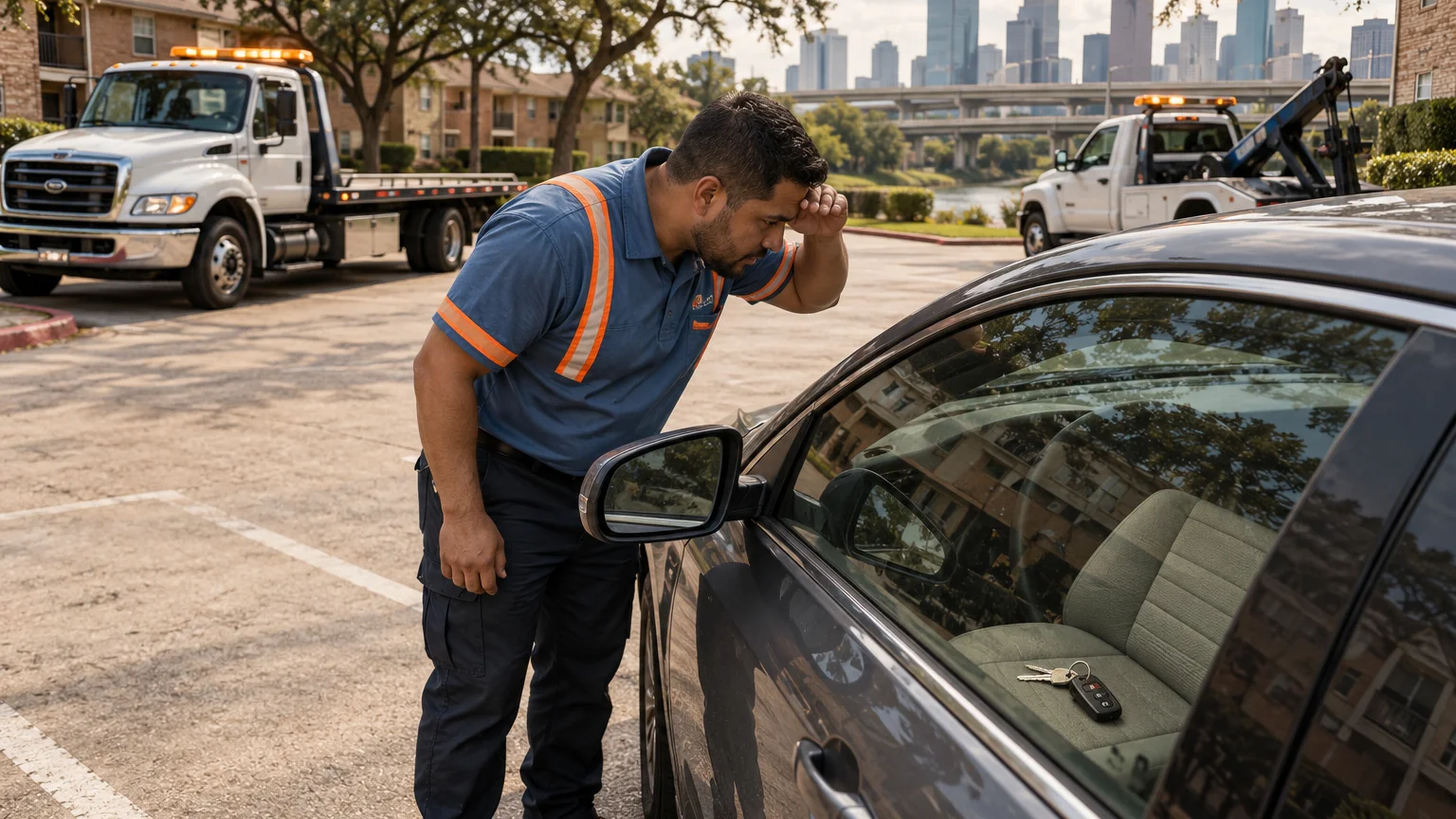
Look through the windows and confirm where the keys are. Note whether they’re on a seat, inside the trunk, or still in the ignition. If the engine is running, tell dispatch immediately.
Next, consider the access options already connected to your vehicle. Some manufacturers provide remote access through an official mobile app. Availability depends on the vehicle, account, and active services. Contact the manufacturer if you aren’t sure whether your car supports it.
A nearby spare key may be the simplest answer. Think about who can safely bring it and whether waiting there is reasonable. Your auto insurer, vehicle warranty, or membership plan may also include roadside benefits. Confirm coverage with the provider before authorizing service.
Avoid online instructions for bypassing a lock. Vehicle doors contain airbags, wiring, sensors, and moving parts. The correct approach depends on the exact model and lock system.
If those options don’t solve it, request car lockout service. Quick Tow Houston connects callers with local operators. The operator confirms whether the vehicle can be serviced and sets the cost. Ask about that cost before dispatch.
When a child, pet, or medical risk changes the call
A person or animal inside the vehicle changes the situation. Heat, illness, breathing trouble, or another immediate danger isn’t a routine car lockout Houston service call.
Contact emergency services by calling 911 when someone faces immediate danger. Follow the dispatcher’s instructions. Don’t wait for a roadside operator to arrive before reporting an emergency.
Tell emergency dispatch exactly where the vehicle is parked. Houston locations can be difficult to describe from a large garage or apartment complex. Give the property name, garage level, nearest entrance, cross street, and visible landmarks. If you’re inside a paid garage, tell staff what’s happening so emergency responders can reach the correct level.
Don’t attempt a forced entry based on an online video. Quick Tow Houston can’t assess a medical emergency over the phone. We also can’t tell you whether breaking glass or using another entry method is safe. Emergency services and the vehicle manufacturer are the appropriate authorities for those decisions.
If there’s no immediate danger, tell our dispatcher who’s inside and what you can observe. The operator still decides whether lockout service is available for that vehicle. Ask the operator for an arrival estimate, since location, traffic, garage access, and current availability can all affect timing.
Stay where you can monitor the vehicle without standing in traffic. If conditions change, contact emergency services.
Garages, apartment lots, and Houston roadside locations
The location matters almost as much as the vehicle. A lockout in a Midtown garage isn’t the same as one beside I-45. Access, clearance, traffic, and property rules can change what an operator can do.
In Downtown or Midtown garages, find the posted garage name and entrance. Note your floor, section, and space number. Check the height sign at the entrance. Tell dispatch about low ceilings, sharp ramps, gates, or ticket requirements.
Apartment parking can create different problems. Gulfton, Spring Branch, and East End properties may have controlled gates or assigned spaces. Arrange entry with the resident, leasing office, or property staff. Tell dispatch if the vehicle is behind a code-controlled gate. Don’t assume an operator can enter without permission.
For retail lots, share the store name and the side of the building. Large centers may have several entrances with similar views. A nearby business sign can help identify your position.
A vehicle beside Loop 610, I-10, Beltway 8, or another busy road needs careful location details. Don’t stand between moving traffic and the car. If the vehicle is on a Houston freeway, review the official Houston Tow and Go program. Its services apply to qualifying disabled vehicles under specific conditions, not every lockout.
Our roadside assistance service covers several common roadside needs. You can also read about getting roadside assistance without AAA in Houston before deciding whom to contact.
Information dispatch needs about the vehicle
Good details help dispatch identify an operator who handles the job. Start with the vehicle’s year, make, model, and color. If you don’t know the model year, give the best identifying information you have without guessing.
Tell dispatch whether it’s a sedan, pickup, van, SUV, motorcycle, or commercial vehicle. Mention any unusual door design, aftermarket alarm, damaged lock, or prior attempted entry. Electric vehicles and luxury models may have service restrictions that the operator needs to review.
Explain where the keys are visible. Say whether they’re inside the passenger area, trunk, cargo compartment, or ignition. Also mention if the vehicle is running. Don’t reach through a small opening or try to move the keys with improvised tools.
Your location should be specific enough for an unfamiliar driver. A street address helps, but it may not identify the correct entrance. Add the nearest cross street, business name, garage level, parking section, or apartment gate.
Dispatch also needs to know whether the vehicle is blocking traffic. Report collision damage, a broken door, or a wheel against a curb. Those details can change the service the operator considers appropriate.
The customer contracts directly with the operator who accepts the request. That operator confirms availability and cost. Before the truck rolls, ask what service is proposed and what information the operator still needs.
If you’re comparing dispatch options, our guide to finding a tow truck near you in Houston explains what location details matter.
When towing may be the next option
A lockout operator may not be able to open every vehicle. The operator could decline service because of the lock design, vehicle condition, access limits, or risk of damage. In that case, towing may be the practical next step.
A tow can move the car to a dealership, repair shop, or another destination chosen by the customer. The receiving location should be able to address the key, lock, or electronic access problem. Confirm that the destination accepts the vehicle before authorizing transport.
Towing may also be considered when the lockout isn’t the only issue. A dead battery, damaged door, failed electronic key, collision damage, or mechanical problem can prevent normal access or operation. Describe the full situation rather than requesting only an unlock.
Garage clearance can limit which towing equipment reaches the vehicle. Tell dispatch about posted height restrictions and tight ramps. The operator decides whether the location and vehicle can be handled safely.
Don’t confuse a lockout with an impound. If your vehicle isn’t where you parked it, first determine whether it was towed. Houston doesn’t use one city-operated impound lot. City tows go to licensed private storage facilities. Search the official Houston vehicle lookup by plate or VIN.
Texas requires tow operators to hold the appropriate TDLR license. You can review towing information through the Texas Department of Licensing and Regulation. The pros in our referral network are licensed and insured, while Quick Tow Houston handles dispatch and referral.
When to call us
Call when your access options haven’t worked and you need an operator to assess the auto lockout. We can also route a licensed towing operator when the vehicle must go to a repair shop or dealership.
Call us at (281) 916-1288 and we’ll connect you with an operator who handles this work.