A lowered car can be towed, but the operator needs accurate details first. Send the vehicle changes, clearance measurements, photos, and access conditions before dispatch. That information helps the operator decide what equipment fits the actual job.
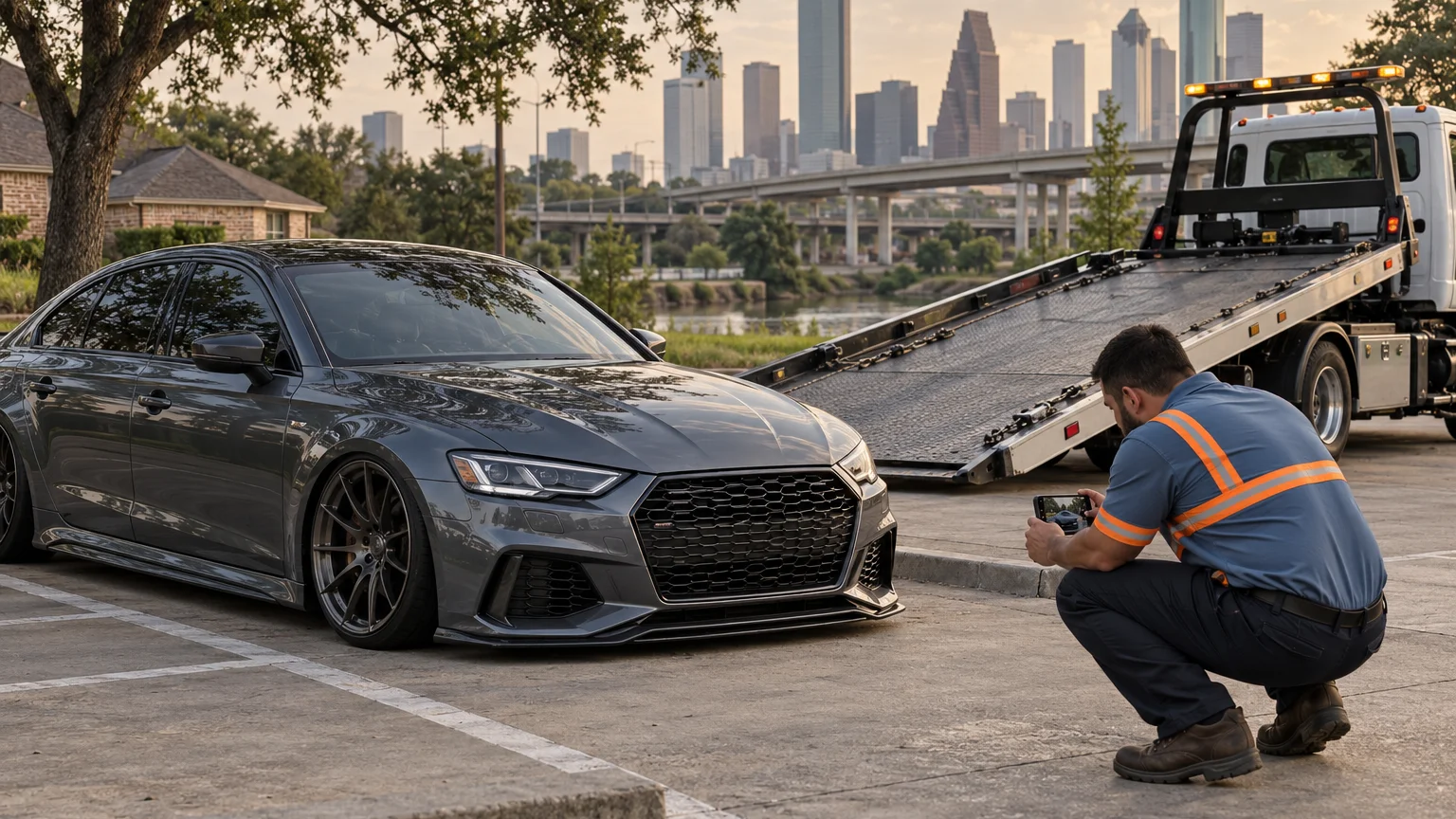
Share the year, model, and vehicle changes
Start with the vehicle’s year, make, model, and trim. Don’t report only “Honda,” “Mustang,” or “BMW.” Different trims can have different body pieces, wheels, and factory equipment.
Tell the dispatcher whether the car sits at factory height. If it doesn’t, describe every change you know about. That can include coilovers, lowering springs, air suspension, a front lip, splitter, side skirts, or an aftermarket exhaust. Don’t guess at brands or specifications. Send photographs when you aren’t certain.
Report whether the suspension can change height. If it uses controls, tell the operator whether they still work. Don’t change a suspension setting unless the operator or vehicle manufacturer directs you. The correct position may depend on the car’s condition and the manufacturer’s instructions.
The operator also needs to know why the car can’t move. State whether it starts, steers, rolls, and shifts into neutral. Report locked wheels, flat tires, missing wheels, steering damage, leaking fluid, or loose bodywork. A lowered car that rolls freely presents a different situation from one resting on damaged suspension.
Mention drivetrain details only when you know them. The owner’s manual or manufacturer can confirm the correct transport instructions. Don’t assume two cars from the same brand require identical handling.
Our exotic and classic car towing referral service covers specialty dispatch needs across Houston. We connect callers with licensed, insured operators, but the operator selects the transport method. For broader preparation guidance, read our classic car towing checklist. It addresses a different concern: preparing an older or collectible vehicle before transport.
Photograph clearance and visible damage
Photos give the operator more useful context than saying the car is “very low.” Take a full view from the front, rear, and both sides. Then photograph the lowest visible areas without placing yourself beneath the vehicle.
Include the front lip, splitter, rocker panels, side skirts, exhaust, and rear bodywork. If a loose panel hangs below the car, show its position. Photograph each wheel and tire as well. These images help document the car’s condition before pickup.
Measure the lowest visible clearance if you can do so safely. Place the measuring tool beside the car and make the markings readable in the photo. Don’t estimate the measurement from memory. Also measure any front or rear body extension that may affect access.
No universal minimum clearance, loading angle, or ramp specification could be confirmed from the approved Houston claims ledger. Those details depend on the vehicle, equipment, surface, and manufacturer guidance. Send the measurements to the assigned operator and ask what else is needed.
Photograph existing scrapes, cracked trim, bent wheels, and damaged suspension parts. Include a wider image showing where each close-up belongs. Keep the original files instead of sending cropped screenshots alone.
Houston pavement can change quickly between a parking space and a driveway entrance. A car in a level Spring Branch lot may still face a steep exit. The same problem appears at parking garages near Downtown and the Texas Medical Center. Include the path from the car to the street, not just the car itself.
If you’re comparing transport options, our guide to when a flatbed may be needed explains the questions to discuss. Photos and measurements still determine what applies to your car.
Describe the pickup and destination access
Tell the dispatcher exactly where the car sits. A street address isn’t enough for a large apartment complex, garage, repair campus, or shopping center. Add the building name, garage level, entrance, gate, and nearest visible landmark.
For a freeway location, report the route, travel direction, and nearest exit. I-10, I-45, Loop 610, and Beltway 8 cover long stretches of Houston. “On I-10” leaves too much uncertainty. State whether the car is near the Inner Loop, the Energy Corridor, or another identifiable area.
Describe the surface beneath the car. Say whether it’s on pavement, gravel, grass, or an incline. Report curbs, speed bumps, drainage dips, tight turns, overhead limits, and narrow gates. Don’t decide whether the truck can enter. Send the details and let the operator assess access.
Parking garages need special attention. Photograph the posted entrance restrictions, turns, ramps, and the space around the vehicle. If the car is behind a controlled gate, arrange access with the property before pickup. Tell the operator about any loading area or property instructions you’ve received.
The destination matters too. Send its full address and describe the final approach. A repair shop on a wide commercial lot differs from a home with a sloped driveway. Pasadena, the East End, Katy, and central Houston also create different route and access conditions.
Confirm that the destination will accept the vehicle. Ask where the operator should place it and who can authorize delivery. Don’t assume a closed gate or crowded shop lot can receive the car.
Photos of both locations are useful. A short video can show the route through a garage or complex. Avoid filming unrelated people or readable private information. The goal is to show access, surface changes, and available working space.
Let the operator select the equipment
You can request a flatbed for a lowered car, but don’t treat that request as the final equipment decision. The operator needs to compare the vehicle’s clearance, condition, wheel movement, access, and manufacturer instructions.
Quick Tow Houston handles dispatch and referrals. We don’t own trucks or choose equipment for the operator. We connect you with a licensed, insured towing operator who evaluates the job and contracts with you directly.
Our flatbed towing service page explains how to request that type of operator. Still, a flatbed isn’t an automatic answer for every modified car. The operator may need more information before confirming a plan. Don’t direct loading, tie-down placement, or equipment setup yourself.
Ask the operator these questions:
- Did you receive the clearance and access photos?
- Do you need another measurement or camera angle?
- Have you reviewed the disabled wheel or suspension condition?
- Does the destination create a separate access concern?
- Should I check the owner’s manual for transport instructions?
Some online discussions mention an “80% rule” for towing. No Houston rule with that name for transporting a lowered passenger car could be confirmed in the approved claims ledger. Don’t apply an unexplained percentage to this job. Ask the operator and consult the vehicle manufacturer for limits tied to your specific car.
Price also depends on the operator and job details. Quick Tow Houston doesn’t set or charge the towing price. Ask the operator to explain the price before dispatch and confirm what information it covers. Don’t rely on a generic online figure for a modified car in Houston.
Texas requires tow operators to hold a TDLR license. You can verify the operator through the TDLR license search and towing information. That check confirms licensing status, not whether a particular truck fits your vehicle.
Review the plan before transport
When the operator arrives, walk around the vehicle together. Point out the lowest visible areas, loose parts, and existing damage. Show the operator the same photos and measurements sent during dispatch. If the car’s position changed, mention that immediately.
Ask the operator to explain the proposed approach before the vehicle moves. You don’t need to direct the technical work. You do need to make sure the operator has accurate information. Correct any mistaken assumption about the suspension, drivetrain, wheel condition, or destination.
Keep keys, wheel-lock tools, suspension controls, and the owner’s manual available when applicable. Tell the operator if any item is missing. Don’t claim a control works unless you’ve confirmed it. A dead battery, locked steering system, or damaged key can change the facts presented during dispatch.
Remove loose personal items when access is safe and permitted. Secure or identify detachable exterior pieces. If collision damage makes something unstable, point it out and let the operator decide how to proceed. Don’t pull, lift, or reposition damaged parts without direction.
Review the destination again before departure. Confirm the address, entrance, contact person, and intended drop location. Houston repair shops may have several gates or shared lots. A precise destination prevents confusion after the car leaves the pickup point.
Ask what documentation the operator provides and keep your own photos. Quick Tow Houston can’t guarantee damage-free transport, and no responsible plan should depend on a vague promise. Clear records and an agreed approach give everyone the same picture of the car’s starting condition.
If the operator sees a problem that wasn’t visible in the photos, pause and discuss it. A different position, blocked access, or hidden damage may require a revised plan. Let the licensed operator make that call.
When to call us
Call when a lowered or modified car can’t be moved normally and needs evaluation by a licensed towing pro. Call us at (281) 916-1288 and we’ll connect you with an operator who handles this work.