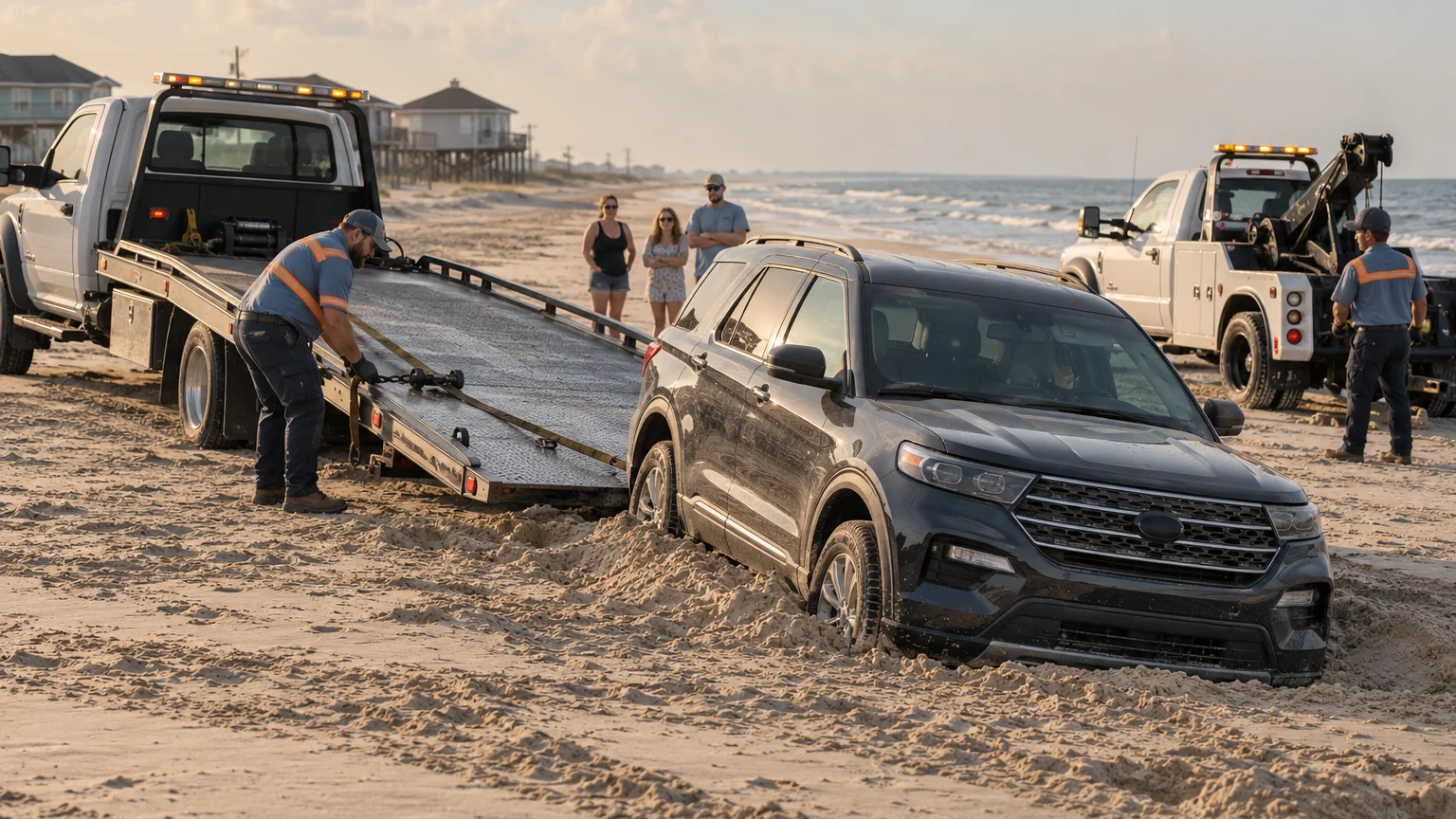
A car stuck in Crystal Beach sand needs professional recovery before it needs more throttle. If you’re searching for “beach recovery near me,” stop driving and gather details for the operator.
Quick Tow Houston dispatches and refers callers to licensed, insured towing operators. The operator handles the recovery, sets the price, and contracts directly with you.
Stop before the tires dig deeper
Once the tires spin without moving the car, stop accelerating. More wheelspin can settle the vehicle deeper into loose sand. It can also make the operator’s approach and recovery more difficult.
Tell the operator whether the engine is running and where passengers are waiting. Mention nearby traffic, moving vehicles, and anything blocking access to the car.
Wait for the operator to explain the connection and pulling plan. Recovery points differ between vehicles, and an incorrect connection can damage the car.
A beach winch out isn’t the same as pulling from a paved parking lot. The operator needs to consider the vehicle’s position, the surrounding sand, and where recovery equipment can approach. A truck that can reach a roadside shoulder may not be able to reach the same spot on a beach.
If the vehicle sits near incoming water, mention that immediately. The approved research didn’t confirm tide guidance or a specific Crystal Beach evacuation rule. Check current conditions with the authority responsible for that access area. Tell the operator if water is already reaching the tires.
Our Winch-Out & Recovery service page explains how we connect callers with operators handling immobilized vehicles. Tell the operator whether another personal vehicle has already attempted a pull. The operator should assess the scene first.
What recovery details to send the operator
A precise location matters more than saying you’re somewhere on Crystal Beach. Drop a map pin from your phone and send it during dispatch. Also provide the nearest visible access marker, road sign, business, entrance, or recognizable landmark.
Describe the vehicle clearly. Include its year, make, model, and approximate size. State whether it’s a car, SUV, pickup, van, motorcycle, or vehicle with a trailer. Tell the dispatcher if it carries passengers, cargo, or anything affecting its weight.
Next, describe how it’s stuck. Useful details include:
- Which tires are buried
- Whether the frame or underside touches the sand
- Which direction the vehicle faces
- Whether the car can steer, brake, and shift
- Whether the engine starts
- Whether any tire is flat or damaged
- Whether water or traffic is approaching
- Whether another vehicle blocks access
Send current photos when possible. Take a wide photo showing the vehicle and surrounding area. Then take side views showing tire depth and ground clearance. If a useful angle isn’t available from your current position, tell the operator.
Mention any collision, leaking fluid, broken suspension, warning lights, or unusual noises. Those details help distinguish a basic beach winch out from accident recovery or a tow.
Tell the operator about any locked wheels, missing keys, or steering problems. Also explain whether a trailer is attached. Complete information helps the operator decide what kind of truck and recovery setup may be suitable. The operator can then explain the proposed work and quote its price before dispatch.
Beach access, tide conditions, and vehicle location
Crystal Beach recovery depends on the exact scene, not just the community name. A vehicle near a marked access route presents a different approach than one farther across soft sand. An operator also needs to know whether the path is open, blocked, narrow, wet, or crowded.
The approved claims ledger doesn’t confirm Crystal Beach access rules, tide restrictions, driving boundaries, or permit requirements. We won’t guess about them. Contact the authority responsible for the specific access point and confirm the current rules before dispatch. Posted signs at the entrance may also identify restrictions or contact information.
Don’t assume every nearby tow operator can enter the beach. Ask whether the operator accepts off-pavement recovery calls at your exact location. Confirm that the operator has reviewed your map pin and photos. If access requires separate permission, ask who must provide it before the truck enters.
Conditions can change between the access route and the vehicle. Tell dispatch about standing water, deep ruts, loose dunes, crowded areas, gates, barriers, or narrow turns. Don’t describe the ground as “easy” unless the operator has seen it. Photos provide better information than a casual estimate.
Your phone’s location label may also identify Crystal Beach without identifying the controlling jurisdiction. Confirm the county or local authority shown on posted signs, maps, or official notices. A Houston business listing doesn’t establish authority over a beach recovery scene.
This differs from a car stranded in a Houston ditch or street. Our guide to a car stuck in a ditch or flooded street covers those paved-road situations. Beach sand creates separate access and positioning questions.
If the operator can’t legally or safely enter through the available route, ask what information or authorization is missing. Don’t move gates, cross posted boundaries, or direct the truck through an unconfirmed entrance.
When recovery may also require a tow
A successful pull doesn’t always mean the vehicle should return to the road. Sand recovery only changes where the vehicle is sitting. It doesn’t repair damage caused before, during, or after it became stuck.
Tell the operator if the car won’t start or shift. Report steering, braking, tire, suspension, or underbody concerns. A collision with another vehicle or fixed object also changes the call. The operator may recommend recovery followed by towing to a destination you choose.
Tell the operator exactly how the steering and brakes respond. The operator can discuss whether the job appears limited to extraction or needs towing after recovery.
A tow may also become necessary when a tire is damaged, a wheel won’t turn, or the vehicle can’t leave under its own power. These are scene details, not a diagnosis. A repair shop should determine what mechanical work the vehicle needs.
If another car tried to pull yours before dispatch, disclose that attempt. Mention where straps were connected and whether anything bent, cracked, leaked, or shifted. Don’t hide prior damage because you’re worried it will complicate the call. The operator needs an accurate picture.
For broader guidance on choosing help, read our Houston tow truck guide. Crystal Beach access still needs separate confirmation because the approved research doesn’t establish local beach-entry rules.
The operator sets the recovery and towing price. Ask what work the quote covers before the truck rolls. Also ask whether a second tow would be priced separately if the car can’t be driven after extraction.
Confirming jurisdiction and access before dispatch
Texas requires tow operators to hold a TDLR license. You can check an operator through the TDLR towing consumer information page and the agency’s license search.
That statewide license requirement doesn’t answer every local beach-access question. The approved research didn’t confirm which agency controls each Crystal Beach entrance or what current conditions allow. Verify the specific access point with the responsible local authority before the operator arrives.
When speaking with dispatch, confirm these points:
- The operator received the correct map pin
- The operator reviewed current scene photos
- The operator knows the vehicle type and condition
- The operator understands that the vehicle is on sand
- The operator knows whether water is approaching
- The planned entrance has been identified
- Any required permission has been confirmed
- The operator will quote the price before dispatch
Ask the operator for an arrival estimate. Quick Tow Houston can’t promise a response window because access, distance, conditions, and operator availability vary. A distant beach location can also require more travel than a Houston roadside call.
Keep your phone available after dispatch. The operator may need another landmark, photo, or updated pin. If the vehicle shifts, water reaches it, access closes, or conditions become dangerous, report that change immediately.
Quick Tow Houston doesn’t own trucks or perform recoveries. We answer the call and connect you with a licensed, insured operator. You contract directly with that operator for the work.
Ask dispatch which operator is coming. Ask that operator to explain the proposed recovery plan. If access remains uncertain, resolve that issue with the responsible authority and operator before equipment enters the beach.
When to call us
Call when your vehicle is buried in Crystal Beach sand, can’t move safely, or may need towing after recovery. This work needs a licensed towing professional when the vehicle’s position, damage, or access makes a simple roadside call unsuitable.
Call us at (281) 916-1288 and we’ll connect you with an operator who handles this work.