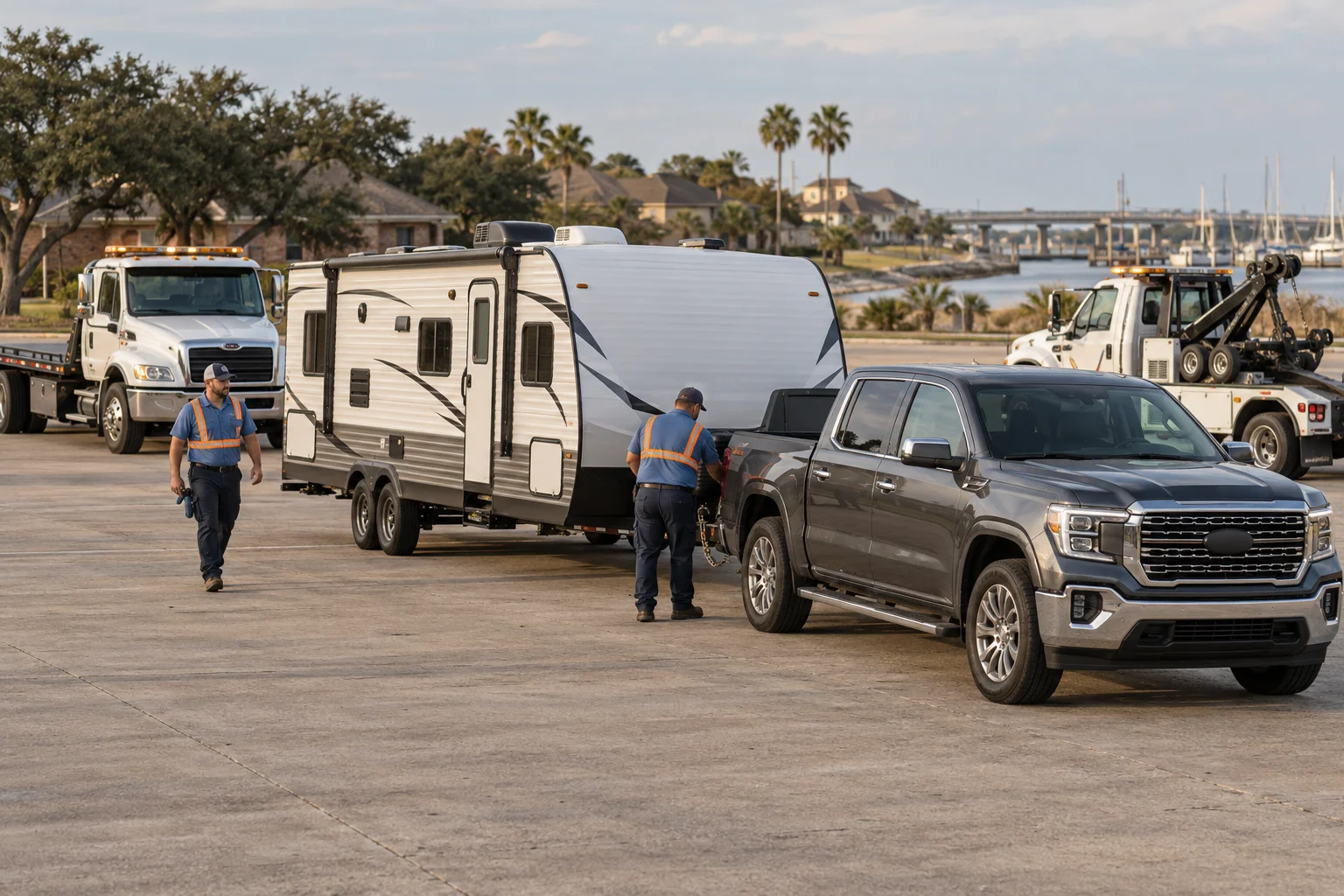
A disabled trailer near League City or Kemah needs more planning than a standard car tow. The operator must understand both the trailer and its tow vehicle. Clear details before dispatch can prevent the wrong equipment from being sent.
Identify the disabled vehicle and trailer
Start by explaining which part of the combination can’t continue. The problem may involve the tow vehicle, the trailer, or both. That distinction changes what the operator needs to evaluate.
Provide the tow vehicle’s year, make, model, and current condition. Then identify the trailer as precisely as possible. It might be a travel trailer, utility trailer, boat trailer, enclosed cargo trailer, or another design. Don’t guess if you aren’t sure. Send photos and describe what you can see.
Look for the trailer’s manufacturer label or paperwork. Share any listed dimensions, identification details, and weight information with the operator. If the label isn’t readable, say so. A clear photo may still help the operator assess the request.
Tell dispatch how the trailer connects to the vehicle. Include photos of the connection, front of the trailer, wheels, and rear. Don’t disconnect anything merely to improve the pictures. The operator should decide what needs to happen after reviewing the setup.
A fifth-wheel breakdown needs its own intake details. Our guide to a fifth-wheel RV breakdown in Houston explains that specific situation.
Quick Tow Houston is a referral service. We connect callers with licensed, insured towing operators. We don’t own transport equipment, and we can’t guarantee every trailer can be moved. The operator makes that decision after reviewing the vehicle, trailer, location, and destination.
Share the exact location and available access
“Near League City” isn’t enough for an operator planning a trailer recovery. Send the exact address, a dropped map pin, or both. Include the road name, travel direction, nearest intersection, and a recognizable entrance.
Local routes can create very different access conditions. A breakdown beside I-45 isn’t the same as one in a lot near FM 518. A trailer near League City Parkway may have different turning space than one closer to Kemah. State which road you’re on instead of naming only the nearest city.
Your legal location also matters. League City extends across Harris and Galveston counties, while Kemah is in Galveston County. Don’t assume dispatch can determine the jurisdiction from a nearby business name. A map pin gives the operator better information.
Describe the available working space. Mention whether the combination is in a travel lane, on a shoulder, inside a marina lot, behind a gate, or within a crowded parking area. Tell the dispatcher about low branches, covered entrances, narrow driveways, soft ground, tight corners, or parked vehicles around the trailer.
If access requires a gate code or property approval, arrange that before dispatch when possible. Don’t promise that a large vehicle can enter just because passenger cars can. Ask the property manager where the operator may enter and work.
Photos should show more than the damaged part. Take wide views of the approach and the open space around the trailer. Stay away from moving traffic while doing so. If you can’t safely take pictures, tell dispatch and wait for the operator’s instructions.
Report cargo, attachments, and visible damage
A trailer’s contents affect the operator’s assessment. Tell dispatch what the trailer carries, even when the cargo appears secure. Don’t describe it only as “loaded.” Name the general cargo and disclose anything that could shift, leak, or require special handling.
Report exterior attachments too. These may include bikes, storage boxes, spare tires, racks, awnings, or equipment mounted behind the trailer. For a boat trailer, identify the boat and send full side views. For a travel trailer, show slide-outs, steps, jacks, and anything hanging below the body.
Don’t claim an attachment is safe because it looks intact. The operator needs to review its position and condition. If something is loose, dragging, bent, or touching a tire, say that plainly. Avoid moving damaged parts yourself.
Photograph every visible problem. Useful images include the damaged wheel area, axle area, hitch connection, trailer tongue, underside, and the full combination from several angles. Photos also help document whether the tow vehicle remains attached.
Tell dispatch about smoke, leaking fluid, fire damage, collision damage, or contact with a barrier. Keep your distance from hazards. A roadside transport request can become a recovery job when the trailer has left the pavement, overturned, or suffered structural damage.
That distinction matters during intake. Standard RV and trailer towing may fit some disabled combinations. Larger or more complicated situations may need an operator who handles heavy-duty towing. The operator, not Quick Tow Houston, confirms the appropriate equipment and scope.
Choose a receiving location before dispatch
Decide where you want the vehicle and trailer taken before the operator starts traveling. A clear destination helps the operator evaluate the entire request. It also exposes access problems before the combination reaches a closed gate or crowded lot.
The destination might be a repair facility, campground, storage property, dealership, marina, or private property. Confirm that the location accepts the specific trailer. A shop that services tow vehicles may not accept trailers. A storage property may also limit entry or require advance approval.
Call the receiving location yourself. Describe the trailer, its condition, and whether the tow vehicle remains attached. Ask where the operator should enter and where the trailer may be placed. Confirm that someone with authority will be available if access depends on staff.
Share the complete destination address with dispatch. Include a gate code, unit number, entrance name, or drop instructions when applicable. If the property has several entrances, identify the one approved for the operator.
Don’t choose an unconfirmed roadside location as a temporary drop point. The operator must agree that the destination is accessible and suitable. Quick Tow Houston doesn’t operate a yard, storage facility, or impound lot.
If you haven’t selected a destination, say so during the first call. The operator may need that decision before accepting the job. You can compare nearby facilities, but don’t assume any business handles your trailer type. Confirm acceptance directly with the property.
For a longer move outside the League City and Kemah area, provide the full route endpoints. The operator sets the price and should explain it before dispatch. Quick Tow Houston doesn’t set towing rates or promise a particular price structure.
Confirm equipment and scope with the operator
Before dispatch is finalized, ask the operator to repeat what they’re preparing to move. The description should include the tow vehicle, trailer type, visible damage, current location, and destination. Correct any missing detail before the truck rolls.
Ask whether the operator has reviewed your photos. Confirm that they understand the available access and whether the trailer remains connected. If the condition changes, send updated pictures. A tire that collapses further or cargo that shifts may change the assessment.
Don’t request a particular loading method based on an online video. Trailer designs and damage conditions vary. Manufacturer instructions may also affect the operator’s plan. If you have the trailer manual or manufacturer guidance, share it directly.
Texas requires tow operators to hold a TDLR license. You can review towing information and verify credentials through the Texas Department of Licensing and Regulation. Quick Tow Houston doesn’t hold the operator’s license because we provide dispatch and referrals, not the towing work.
Confirm the scope directly with the operator. Ask whether the quoted work covers the tow vehicle, trailer, cargo situation, and planned destination. The operator sets the price. Ask about any change before authorizing added work.
Also ask the operator for an arrival estimate. Quick Tow Houston can’t promise when an operator will reach League City or Kemah. Availability, distance, access, and the equipment required can all affect scheduling.
Keep your phone available after dispatch. The operator may need a better landmark or another photo. If you’re leaving the scene, tell both dispatch and the operator where the keys are and who can authorize the move.
When to call us
Call when a travel trailer or attached trailer can’t continue safely and needs a licensed towing professional. Have your photos, specifications, location, access notes, and receiving address ready. Call us at (281) 916-1288 and we’ll connect you with an operator who handles this work.