A disabled car in Houston may need a wheel-lift or a flatbed. The right choice depends on the vehicle, its condition, and where it sits. Share those details before dispatch so the operator can choose suitable equipment.
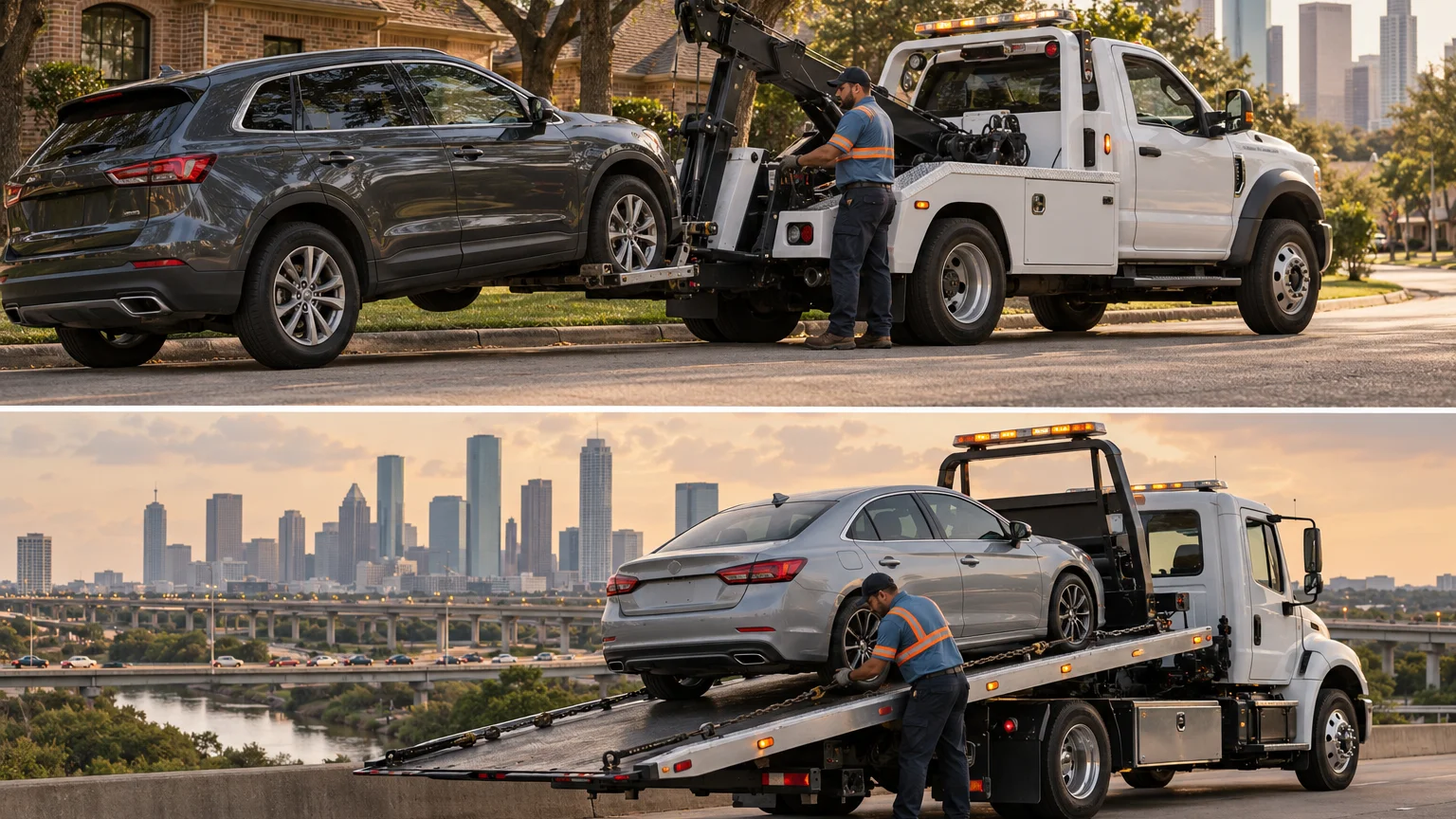
How wheel-lift and flatbed transport differ
The main difference is where the vehicle’s wheels sit during transport.
A wheel-lift truck raises one end of the vehicle. A fitted lifting assembly supports the wheels at that end. The other wheels remain on the road while the operator moves the vehicle. This setup can work in places where loading space is limited.
A flatbed tow truck carries the vehicle on its bed. The operator loads the vehicle onto the platform, then secures it for transport. Its wheels don’t remain on the roadway during the trip.
That difference doesn’t make either method right for every call. The operator must consider the vehicle’s drivetrain, condition, and manufacturer instructions. The pickup area matters too. A flatbed needs a workable loading position, while a wheel-lift still needs enough room for a controlled connection.
Houston adds several different operating environments. A downtown pickup isn’t the same as a shoulder along I-45. An apartment garage in the Inner Loop isn’t the same as an open lot near Beltway 8. Traffic, access, and the vehicle’s position can change the equipment decision.
Our wheel-lift towing service connects callers with operators who handle partial-lift transport. Our flatbed towing service covers calls where the dispatched operator selects a carrying platform. Quick Tow Houston doesn’t own either truck type. We gather the details, relay them, and connect you with a licensed, insured operator.
Vehicle details that affect the operator’s choice
Start with the year, make, model, and trim. Don’t stop at “Toyota SUV” or “Ford truck.” Different versions of the same model may have different drivetrains or towing instructions.
Tell dispatch whether the vehicle is front-wheel drive, rear-wheel drive, all-wheel drive, or four-wheel drive. If you don’t know, say so. The operator can identify what must be checked before selecting a method.
Describe the vehicle’s present condition. Mention any visibly damaged wheel, tire, axle area, or suspension area. Report leaking fluid, loose bodywork, or deployed airbags. Don’t crawl under the vehicle to inspect it beside traffic.
The operator also needs to know whether the wheels turn and roll. Say whether the steering is locked, the transmission shifts, and the parking brake releases. If you can’t test something without forcing it, leave it alone. A vehicle that won’t roll may require a different loading plan.
Keys matter because they can affect steering, shifting, and access. A tow may still be possible without them, but dispatch needs advance notice. Our guide to towing a car without keys explains the information to gather before calling.
Also mention modifications. Low bodywork, altered suspension, oversized tires, or an attached trailer can change the call. Don’t assume the operator will see those details from a basic vehicle description.
For a flat tire, explain whether you have a usable spare and whether the vehicle is away from moving traffic. A tire service may fit some situations. Wheel, suspension, or collision damage may call for towing instead. Let the operator decide after hearing the full condition.
Tight garages and short urban moves
Downtown Houston creates an access problem that vehicle details alone can’t answer. Parking garages may have posted height limits, sharp turns, narrow ramps, controlled gates, and little loading room. A truck that fits on the street may not fit near the disabled car.
Give dispatch the garage name or street address. Then describe the exact level and parking position. Say whether the car faces a wall, sits between other vehicles, or blocks a ramp. Mention overhead pipes, hanging signs, gate arms, and any posted clearance.
Don’t guess a clearance measurement. Read the posted sign and pass along its exact wording. The operator must confirm whether the assigned equipment can enter. Building management may also control truck access, loading areas, or gate entry.
Street pickups need similar detail. On Travis Street, Smith Street, or another downtown route, tell dispatch which side of the street you’re on. Include the nearest cross street and whether the vehicle occupies a travel lane, curb space, or garage entrance. That’s more useful than sending only a location pin.
A short move doesn’t automatically mean wheel-lift towing is suitable. Distance is only one part of the decision. The vehicle’s drivetrain, rolling condition, and manual instructions still apply. Likewise, requesting a flatbed doesn’t mean one can load from every confined position.
If the vehicle is on I-45, I-10, Loop 610, or another freeway, stay away from moving lanes. Houston’s Tow and Go program covers qualifying attended disabled vehicles on eligible freeways, with exclusions listed by the city. Review those terms before assuming a particular tow applies.
When to check the owner’s manual first
Check the owner’s manual whenever the towing method isn’t clear. Look for sections titled “towing,” “emergency towing,” “recreational towing,” or “transporting the vehicle.” The wording varies by manufacturer.
Follow the instructions for your exact model and model year. Don’t rely on advice written for a similar vehicle. A matching body style doesn’t confirm matching towing requirements.
The manual may describe allowed wheel positions, transmission settings, or required procedures. We can’t confirm those requirements without the manufacturer’s instructions. If the manual calls for a specific method, tell dispatch before an operator heads out.
You can often find the manual in the glove box or through the manufacturer’s official website. Use the vehicle identification number when the site offers that option. Save the relevant page on your phone, especially if the car is parked where reception may become unreliable.
Don’t attempt a procedure you don’t understand. Forcing a shifter, releasing a brake incorrectly, or changing a vehicle setting may create another problem. Tell the operator what the manual says and let that operator handle the towing setup.
This check matters for electric vehicles, all-wheel-drive vehicles, modified cars, and vehicles with collision damage. It also matters when the car won’t enter neutral or has no working key. None of those details creates one universal answer for every model.
Our guide to when a flatbed tow may be needed offers more questions to consider. It doesn’t replace the manufacturer’s instructions or the operator’s on-scene assessment.
What to confirm before the operator heads out
A good dispatch starts with a precise pickup description. Give the street address, garage level, cross street, or freeway direction. A Houston location such as “I-10 near Beltway 8” still needs a direction and a safer identifying landmark.
Then confirm these details with dispatch:
- The vehicle’s year, make, model, and trim
- Its drivetrain, if known
- Whether you have the keys
- Whether the transmission shifts into neutral
- Whether the steering and parking brake release
- Whether every wheel appears attached and able to roll
- Any visible collision, tire, wheel, or suspension damage
- The posted garage clearance and access restrictions
- The destination and expected route
- Any manufacturer towing instructions you found
Photos may help the operator understand access and damage. Take them only from a protected location. Don’t enter traffic or stand between vehicles to get a better angle.
Confirm which equipment the operator plans to send. If you requested a flatbed, ask whether the access description allows it. If a wheel-lift is proposed, mention any manual language that affects wheels remaining on the road.
The operator sets the price, not Quick Tow Houston. Ask the operator what the quoted amount covers before dispatch. Confirm the destination, payment method, and any condition that could change the work. We don’t publish or promise a brand towing rate.
Texas requires tow operators to hold a TDLR license. You can check a license through the state’s towing consumer information page. Quick Tow Houston serves as the dispatch and referral point. Your service agreement is with the operator who performs the tow.
When to call us
Call when a disabled or damaged vehicle needs a licensed towing professional, especially when drivetrain, garage access, or wheel condition affects the equipment choice. Call us at (281) 916-1288 and we’ll connect you with an operator who handles this work.