A disabled car inside a garage needs more planning than a curbside pickup. For parking garage towing in Houston, share the exact entrance, level, posted clearance, and vehicle condition before an operator is dispatched.
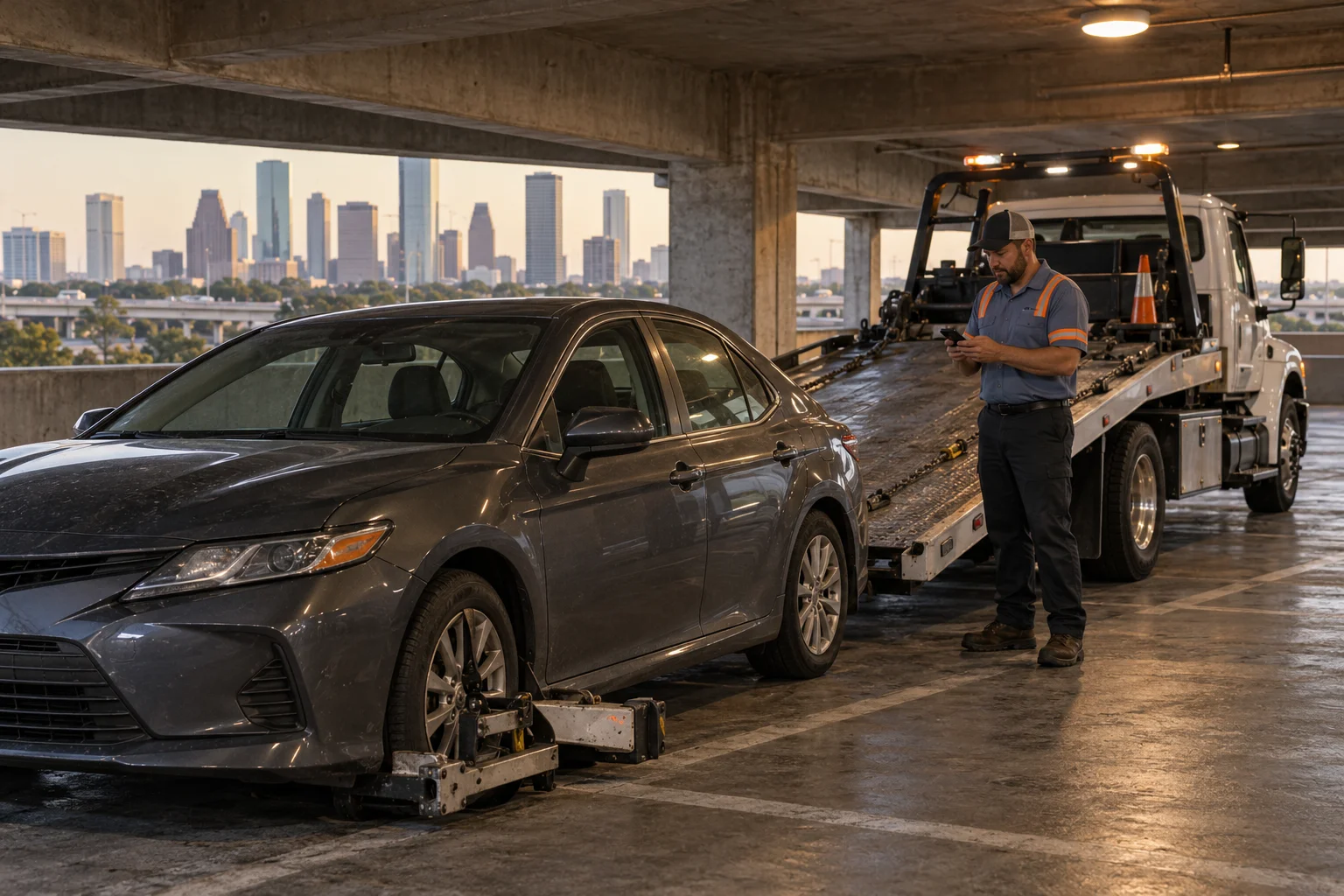
Share the garage entrance and vehicle level
Start with the garage’s full name and street address. Then identify the entrance nearest your car. Downtown garages may have doors on different streets, and a driver sent to the wrong side can’t plan from your description alone.
Include the nearest cross street or recognizable destination. In Downtown, that might mean a garage near Main Street, Louisiana Street, Discovery Green, or the Theater District. In Midtown, name the entrance and its closest intersection. Inside the Texas Medical Center, include the hospital, clinic, or campus building connected to the garage.
Tell dispatch which level holds the car. “Third floor” is more useful than “near the elevators,” but both details together are better. Note the row, section, pillar marker, or painted zone. If the garage uses separate names for connected structures, copy the exact wording from the nearest sign.
A dropped location pin helps identify the property. It may not show the correct entrance or your position inside the structure. Send photos of the exterior entrance and the signs near your car.
Also say whether you have the keys. A missing key changes what the operator must assess. Our guide to towing a car without keys explains what information matters in that situation.
Quick Tow Houston routes your request to a licensed, insured operator. We don’t own towing equipment or control garage access. Clear location details let the operator decide whether the assignment fits before traveling to the property.
Report clearance, turns, and blocked access
Photograph every posted clearance sign you can safely reach. Capture the sign at the street entrance and any lower-clearance warning inside. Don’t estimate the height from memory. The operator needs the posted information to evaluate access.
Garage access involves more than the entrance. Send photos of the path between the entrance and your car. Include curved ramps, tight corners, overhead pipes, hanging signs, gates, ticket arms, speed bumps, and narrow passages. A short video can show the route more clearly than several disconnected images.
Tell dispatch about anything temporarily blocking access. That may include a closed lane, construction barrier, loading activity, event control point, or another disabled vehicle. Don’t move cones, gates, or garage equipment. Contact garage management and ask which entrance an outside towing operator may use.
If a ticket, access card, validation, or staff approval is required, confirm that process with management. Property procedures vary, and Quick Tow Houston doesn’t set them. Ask whether an attendant must open a gate or meet the operator.
The posted clearance does not, by itself, confirm which towing method will work. The operator must compare the garage route, vehicle position, and available equipment. You can read about wheel-lift towing and flatbed towing, but don’t choose equipment from a website description alone.
Avoid trying to pull the car toward the entrance with another vehicle. Garage recovery should follow the plan confirmed by the towing operator and property staff.
Explain whether the car can roll or steer
The operator needs a plain description of what the car can do. Say whether it starts, shifts out of park, rolls, steers, and has working brakes. If you don’t know, say that instead of testing something you’re unsure about.
Describe the position of the vehicle. Is it centered in a space, against a wall, facing a pillar, stopped on a ramp, or partly blocking a travel lane? Note how much open space appears in front, behind, and beside it. Photos from all four corners provide useful context.
Mention visible damage without diagnosing it. Report a flat tire, damaged wheel, hanging body panel, leaking fluid, collision damage, or wheels turned sharply toward a curb. Tell the operator if the parking brake won’t release or the steering wheel is locked. If the dashboard shows a message, send a clear photo of the display.
Vehicle details matter too. Provide the year, make, model, and body style. Mention any modifications that visibly change its height or ground clearance. Don’t guess the weight, drivetrain, or required towing method if you can’t confirm them.
A car that rolls and steers presents a different situation from one locked in place. That still doesn’t settle whether a wheel-lift or flatbed approach is appropriate. Our wheel-lift versus flatbed guide explains the general comparison. The assigned operator makes the final call after reviewing the actual garage.
Keep the travel lane open when possible, but don’t attempt an unplanned extraction. Follow directions from garage staff while you wait for the operator’s assessment.
Downtown, Midtown, and Medical Center garages
Houston’s central districts require precise directions. “A garage near Downtown” won’t identify the correct building, entrance, or access route.
For a Downtown call, provide the garage name and the street-facing entrance. Add the nearest cross street and nearby destination. A location near Market Square differs from one near the George R. Brown Convention Center, Toyota Center, or the Theater District. If an event has changed street access, tell dispatch which entrance remains open.
For Midtown, include the exact block and entrance. Streets such as Main, Travis, Fannin, Bagby, and Louisiana continue through or near more than one central district. A street name without a cross street can send an operator to the wrong area.
The Texas Medical Center needs even more detail. Name the hospital, clinic, office, or campus building served by the garage. Then provide the garage name, entrance street, level, and section. Major streets such as Fannin, Holcombe, Cambridge, and Bertner help orient the operator, but the connected building is often the clearest identifier.
In every district, ask management whether the garage has a designated access point for towing operators. Confirm whether staff must meet the operator at a gate. Quick Tow Houston can pass those instructions along, but we can’t authorize entry.
If the car is on a public street rather than inside the garage, say so immediately. A garage assignment and a street pickup involve different access conditions. Accurate jurisdiction and property details also help avoid confusion between a consent tow requested by you and a vehicle removed without the owner’s consent.
Confirm the recovery plan with the operator
Before dispatch is finalized, ask the operator to review the garage details and photos. Confirm that the operator understands the posted clearance, vehicle level, ramp route, car position, and whether the wheels can move.
The operator should decide what equipment and access plan fit the situation. Don’t treat a photo review as permission from the property. Garage management controls entry, gates, and property procedures. Get any required approval before the operator arrives.
Ask where the vehicle will be taken. Provide the repair shop, dealership, home, or other destination. Confirm that the destination can receive the vehicle when it arrives. If you haven’t selected a destination, tell the operator before dispatch rather than making that decision during removal.
The operator sets the price, not Quick Tow Houston. Ask the operator to explain the charge before the truck rolls. Garage conditions may affect the proposed work, so disclose access problems during the first conversation.
Texas requires tow operators to hold a TDLR license. You can check a license through the TDLR towing consumer information page. Quick Tow Houston connects callers with licensed, insured operators, but the customer contracts directly with the operator performing the work.
Stay available by phone in case the operator needs another photo or entry instruction. Ask the operator for an arrival estimate, since timing depends on operator availability, traffic, and confirmed garage access.
When to call us
Call when your car won’t move and the garage requires a licensed towing professional to assess access and removal. Call us at (281) 916-1288 and we’ll connect you with an operator who handles this work.