A stalled car near Clear Lake can leave you between several possible destinations. A Bay Area towing service needs your exact road, direction, vehicle condition, and preferred drop-off point.
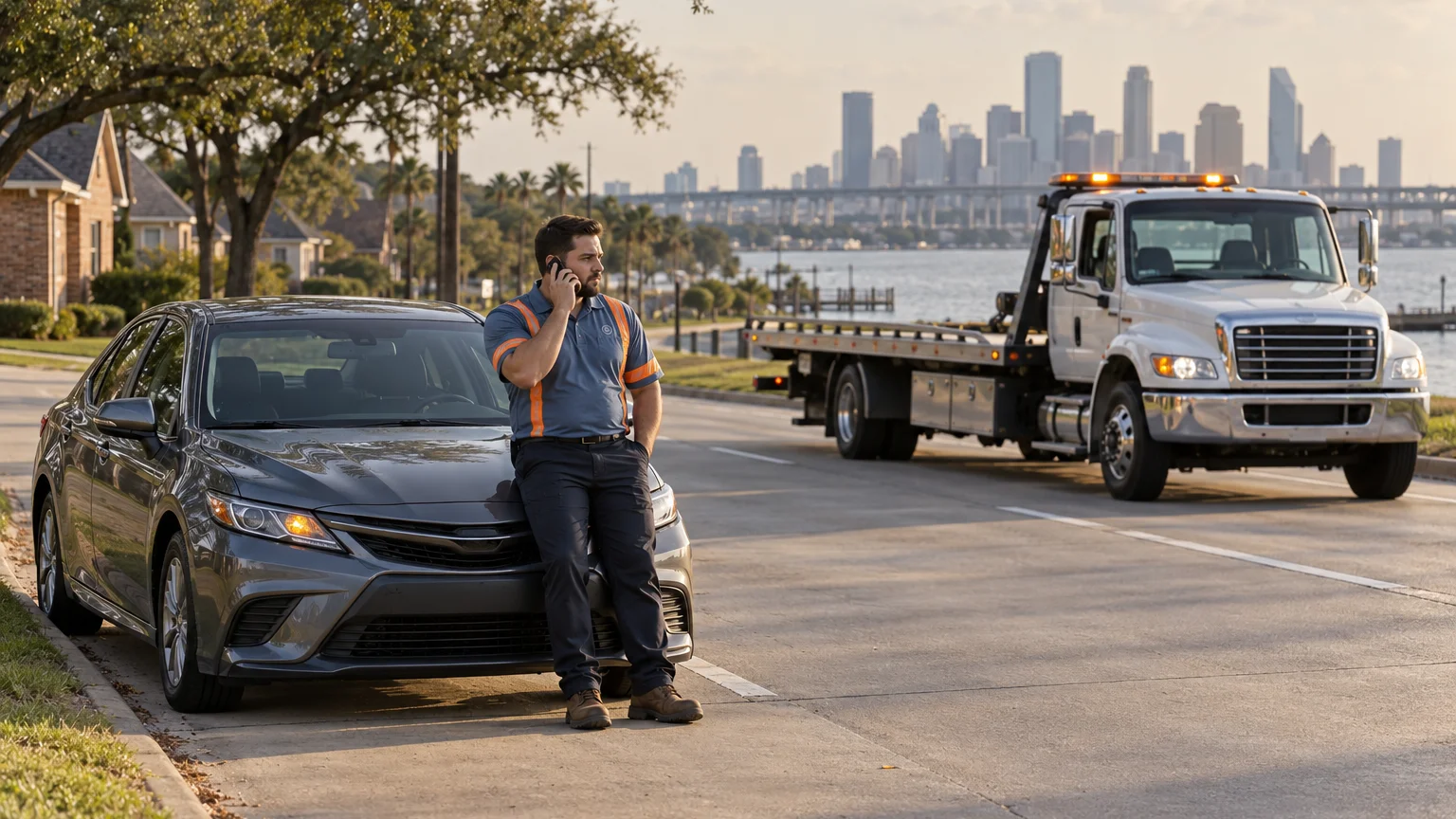
Clear Lake, Webster, and the NASA-area roads form one connected travel zone. They aren’t one interchangeable location, though. A pickup near Bay Area Boulevard may need a different route than one near NASA Parkway, I-45, or League City.
Quick Tow Houston is a dispatch and referral service. We collect the details and connect you with a licensed, insured towing operator. The customer contracts directly with that operator.
Send the road, direction, and nearest confirmed landmark
Start with the road name shown on a sign or map. Then give your direction of travel and the nearest confirmed cross street. “NASA Parkway near Bay Area Boulevard” is more useful than “somewhere by Clear Lake.”
Clear Lake callers often describe the whole area as Houston. That can leave dispatch searching across too much ground. Say whether you’re near Clear Lake, Webster, League City, or the I-45 corridor. If your map shows a different city name, share it exactly as displayed.
Useful location details include:
- The road and direction you were traveling
- The closest cross street or freeway exit
- A visible business, hospital, hotel, or shopping center
- Whether you’re on a shoulder, frontage road, driveway, or parking lot
- The parking level or entrance when inside a garage
- Your vehicle’s color, make, model, and plate state
Don’t guess at a landmark you can’t confirm. Drop a map pin instead. A screenshot can also help when road names change or several entrances look alike.
Access matters around large campuses, apartment complexes, medical buildings, and controlled parking areas. Tell dispatch whether there’s a gate, ticket arm, low clearance, security desk, or restricted entrance. We can pass that information to the operator, but the property contact decides its access rules.
A breakdown on I-45 needs different handling from one in a Webster parking lot. Houston’s Tow and Go program may provide a no-cost tow of an attended disabled vehicle from an eligible freeway to a safe location about one mile away. Tollways and Katy Freeway HOT lanes are excluded. Law enforcement or Houston TranStar must authorize that tow.
Choose roadside help or vehicle transport
The next decision is whether the car needs a small roadside service or transport. Describe what happened before choosing. Warning lights, smoke, leaking fluid, collision damage, a dead battery, a flat tire, or a lost key point toward different needs.
A simple problem may fit roadside assistance. Common requests include a jump start, tire help, fuel delivery, or lockout service. Tell dispatch whether you have a usable spare tire, where the keys are, and whether the engine responds when you try starting it.
Roadside work isn’t always enough. A car may start but still be unsuitable to drive. It may also have damaged steering, a wheel problem, cooling trouble, or collision damage. Dispatch needs the symptoms, not your diagnosis.
If the vehicle needs transport, our emergency towing referral service can connect you with an operator. Say whether the vehicle is a sedan, crossover, pickup, electric vehicle, lowered car, or modified vehicle. Those details help the operator decide what equipment may fit the job.
The choice can also depend on your destination. A working spare might solve a tire problem near Webster. A missing spare means the car may need transport to a tire shop, home, or another approved location.
Our guide to choosing roadside assistance or a tow truck explains that decision in more detail. When you’re unsure, give dispatch the full symptom list. The operator can confirm what service is appropriate before work begins.
The operator sets and quotes the price. Confirm the service, destination, and price directly with that operator before pickup. Quick Tow Houston doesn’t set towing rates or charge for the operator’s work.
Describe whether the car can roll or steer
A car’s movement tells the operator more than “it won’t drive.” Report whether it can roll, steer, brake, start, and shift into neutral. Don’t force any control that’s stuck or damaged.
Start with the wheels. Say whether every tire is attached and inflated. Mention a wheel that points at an unusual angle, rubs the body, or appears trapped against a curb. If the vehicle sits unusually low, share that too.
Next, describe the car’s position. A car parked straight in an open Webster lot presents different access than one nose-first inside a tight garage. The same applies to a vehicle beside a median on NASA Parkway or close to moving traffic near I-45.
Tell dispatch about:
- Locked steering or missing keys
- A shifter that won’t leave park
- Brakes that won’t release
- Collision damage near a wheel
- A missing, flat, or detached tire
- Low ground clearance
- A narrow entrance or overhead clearance
- The vehicle facing away from the available exit
Photos can help the operator understand access. Capture the whole car, the damaged area, and the open space around it. Don’t move into traffic to take a better picture.
Electric vehicles and all-wheel-drive cars may have model-specific transport instructions. Give the exact year, make, and model. The operator can then determine the suitable loading method.
If the car can’t shift, see our guide to towing a car that won’t go into neutral. Accurate details reduce surprises when the operator reaches the vehicle.
Texas requires tow operators to hold a TDLR license. You can check an operator through the state’s license search, linked from the TDLR towing consumer page.
Compare Clear Lake, Webster, and League City destinations
Choose the destination before the vehicle is loaded when possible. That decision affects the route and the operator’s quote. “Take it somewhere nearby” isn’t specific enough.
Clear Lake destinations may make sense when your home, mechanic, or dealership is already in that area. Webster has repair shops and commercial destinations near Bay Area Boulevard and the I-45 frontage roads. League City may be the better direction when your regular shop or home lies farther south.
The closest destination isn’t automatically the right one. A nearby shop may be closed, unable to accept the vehicle, or unsuitable for its problem. Call the destination and confirm that it will receive the car. Ask where the operator should leave it and who will accept the keys.
Consider these details before deciding:
- Whether the destination accepts your vehicle type
- Which entrance the operator should use
- Whether someone will meet the operator
- Where the keys should go
- Whether the property allows an after-hours drop
- Whether a gate, garage, or loading area limits access
Those policies aren’t confirmed by Quick Tow Houston. Check them directly with the shop, property manager, dealership, hotel, or campus contact.
Keep the distance clear when requesting a Bay Area towing service. A trip from Webster toward League City differs from a short move within Clear Lake. A destination back toward central Houston is another route entirely. Give the complete street address, not just the business name.
Passenger-car breakdowns also differ from trailer problems along the same corridor. Drivers handling a trailer can use our separate guide to a trailer breakdown near League City and Kemah.
Confirm access and destination with the operator
Before dispatch, repeat the pickup and destination details. A small correction now can prevent the operator from approaching the wrong entrance. Confirm the city, road, direction, cross street, and map pin.
Then review access. Mention gates, parking decks, low ceilings, narrow lanes, security checkpoints, or a vehicle blocked by other cars. If you’re on private property, ask the property contact where the operator may enter and load.
NASA-area properties can have rules set by the specific facility. Quick Tow Houston doesn’t publish unconfirmed access requirements. Contact the property owner, security desk, facility contact, or applicable public authority for current instructions. Pass those instructions to the operator.
Confirm these points directly with the operator:
- The service being sent
- The exact pickup point
- The full destination address
- The vehicle’s rolling and steering condition
- Access limits at both locations
- Who will release and receive the vehicle
- The operator’s quoted price
- The accepted payment method
Ask the operator for an arrival estimate. Conditions, distance, access, and operator availability can affect timing. Quick Tow Houston doesn’t promise an arrival window or guarantee that an operator is already nearby.
Keep your phone available after dispatch. The operator may need a clearer landmark or entrance. If your location changes, update dispatch and the operator instead of assuming they’ll see you.
Check the operator’s name and company before releasing the vehicle. You can also request the TDLR license information and verify it through the state search. Texas tow operators must display their TDLR license and wear reflective gear while working outside the truck.
Finally, remove any items you’ll need before the car leaves. Confirm where the keys will be delivered. If another person will receive the car, share that person’s name with the operator and destination.
When to call us
Call when a passenger car near Clear Lake, Webster, or NASA-area roads needs roadside help or transport from a licensed towing professional. Call us at (281) 916-1288 and we’ll connect you with an operator who handles this work.